Mao Zedong Quotes
After the countrywide victory of the Chinese revolution and the solution of the land problem, two basic contradictions will still exist in China. The first is internal, that is, the contradiction between the working class and the bourgeoisie. The second is external, which is the contradiction between China and the imperialist countries. Consequently, after the victory of the people's democratic revolution, the state power of the people's republic under the leadership of the working class must not be weakened but must be strengthened.
Mao, Zedong. "Report to the Second Plenary Session of the Seventh Central Committee of the Communist Party of China." Selected Works of Mao Tse-Tung, vol. 4, Foreign Languages Press, 1961, p. 369.


Vladimir Lenin. Most did not and the Communist government was brutal and murderous in forcing them into the Communist culture, outlook, and behavior. See {640096} for a description of some of the effort.

Vladimir Lenin. While Lenin was of this view, Stalin and other hard liners disagreed. They not only imposed their brand of communism on their own people via force with terrible consequences for any dissidents, but the Soviet Army imposed Communism on most of the states of Eastern Europe, and those states in turn used their Armies and secret police to impose it on their own citizens.

Vladimir Lenin


This is an example of what made the Cold War so difficult. The Italian Communists had great misgivings about the Russian version of Communism that tended to abuse human rights and try and control other countries. However, when the Russian Communists were under world attacks by the West, as with their incursion into Hungary, he urged that all the Communists stick together and defend the Russians even for policies that they thought wrong. On the West side, the same thing occurred. The United States tolerated and supported a number of terribly oppressive dictatorships that were virulently anti-Communist. Polarization was the international norm.

After the 1917 Russian Revolution many of the Western Countries sent troops to Russia where they aided the Whites against the Reds. When the Red Bolsheviks prevailed, there were many attempts to diplomatically and economically undermine the Communist government. This caused a unity among different Russian factions. Sforza urged leaving them alone and letting the Bolsheviks fail by their own ideology. Most Western nations and the United States did not agree with him.

The occasion for the speech was the 60th birthday of Russian Premier, Joseph Stalin.


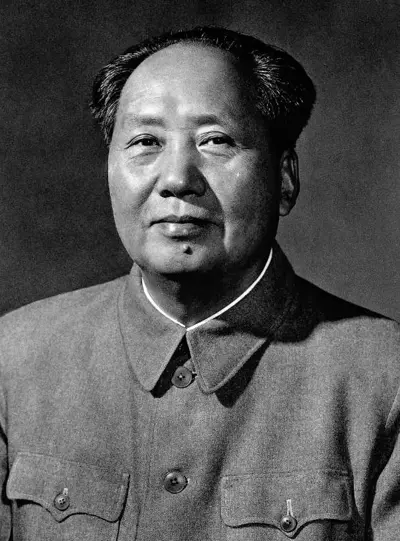
Mao Zedong, also known as Chairman Mao, was a Chinese communist revolutionary who was the founder of the People's Republic of China (PRC), which he ruled as the chairman of the Chinese Communist Party from its establishment in 1949 until his death in 1976. Ideologically a Marxist–Leninist, his theories, military strategies, and political policies are collectively known as Maoism.
