Lyndon B. Johnson Quotes
I don't care what kind of speeches you make as long as you don't vote against the appropriations.
Many members of his own party opposed some of the President's policies and programs, and party loyalty and discipline were strained:
Lyndon Baines Johnson, 1908-1973, 36th President of the United States (Democrat, TX), Quoted in Washington Monthly, August 1971
Sourced by: Eigen's Political and Historical Quotations


In subsequent years military officers got around this restriction by privately expressing confidential opinions to members of Congress and the press. In the Iraq war for example most senior military officers felt that more troops were needed in Iraq. However, since the President decided on the final troop count only one official, the Army Chief of Staff, has publicly expressed the view that it was insufficient. He was retired early. The stricture still stands.


of requests from conservative Congressmen who want pork projects added to appropriation bills In one of the great ironies of Washington, Dyer was named “Porker of the Year” yet there was no pork placed in appropriations bills that were not specifically requested (insisted upon) by a member of Congress.


Then running for reelection as a state legislator.

The Navy developed a program to disperse the home bases of the U. S. based fleet. They called it "home porting" which became "home porking" to detractors who accused the navy of spreading out the money in order to curry favor with congress rather than making cost effective military decisions. One opponent of the program was Barry Goldwater, the senior senator from Arizona—a landlocked state:


The President-elect was very circumspect with respect to Congress:


At the time, most members never read the bills they voted on, though some tended to read earlier versions. The bills were very long—sometimes as long as 2000 pages. Usually a few members of Congress worked with Congressional Staffs and lobbyists to finalize bills. It was believed that the lobbyists were the only people who read the entire bills in all their versions.

The Cloture motion was the motion to terminate the Southern Filibuster against the Civil Rights Act of 1964. Johnson needed substantial Republican support as the Solid Democratic South was all opposed to any kind of civil rights legislation. What is interesting is that Johnson, known as the champion arm twister, knew when to twist and when not to. Mundt, although a serious conservative and generally opposed to the Federal government controlling local human interaction, had also been a school superintendent and was a decent and fair-minded man who was personally offended by the over a century of unfair discrimination and overt racism. Johnson would either have Mundt’s vote from conviction or he would not get it, and pressure was not likely to work with him.

Explaining his opposition to civil rights legislation:


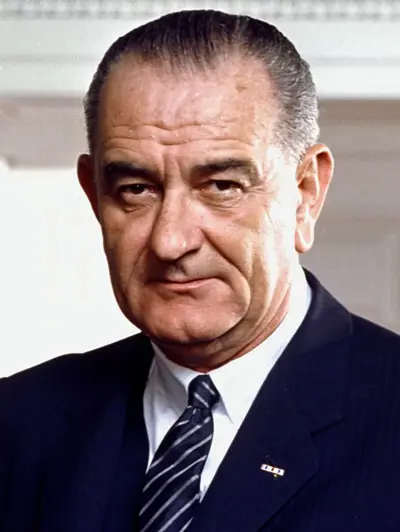
Lyndon Baines Johnson, often referred to by his initials LBJ, was the 36th president of the United States, in office from 1963 to 1969. He served as the 37th vice president from 1961 to 1963 and assumed the presidency following the assassination of President John F. Kennedy. A Democrat from Texas, Johnson was also a United States representative and later majority leader in the United States Senate. Johnson is one of only four people to have served, at various times, in all four federal elected positions.
