Lyndon B. Johnson Quotes
I don't believe the President of the United States should debate with anybody.
Lyndon Baines Johnson, 1908-1973, 36th President of the United States (Democrat, TX), December 15,1963
Sourced by: Eigen's Political and Historical Quotations


Played the President in the NBC Network West Wing


Truman had no rich supporters and the radio networks, like most businesses, supported his Republican opponent, Thomas E. Dewey. They charged high rates for a campaign speech. Truman could not afford to pay for the radio speech which convinced most that he could not possibly win.


He was asked if he supported President Donald Trump, whose first 100 days was in the view of most political analysts, historians and many politicians--almost all Democrats and even many Republicans to be one of the worst on record. His popular approval rating was the worst after 100 days than any other President since support polls had been started. Kasich had stringly opposed Trup in the 2016 election. His answer reflected his view that al should support whatever president was in office even thought they might at the same to be very critical and opuitspoken about his weaknesses and failings. The President is everyone's President even though he may not act like it.

He was responding to criticism that the media was bashing the President.


During his Ambassadorial confirmation hearings Helms lied about the role the CIA under his direction had played in the destabilization of Chile and the Allende administration. In 1977 he was convicted of perjury. He was not convicted for carrying out any presidential orders but for lying under oath to Congress. No President had ordered him to do that. The CIA had covertly aided in a coup usurping the popular, elected President Salvador Allende—today a national hero in Chile. We picked the wrong side in the political battle in Chile. We helped a military dictator overthrow a democratically elected president. See {622168}.


Hamilton thought that the Executive Branch should be co-equal with the Judicial Branch and lifetime tenure should apply to both. This quotation is very important as we consider developing countries and emerging democracies. Some in the third world have Presidents for Life—a concept that most democracies scoff at. But the stability and the independence was important enough to some of the Founding Fathers was actually advocated and considered as we formed the American Democracy.

Dr. Sovern played Ronald Regan in the debate preparation of Walter Mondale
That is one view—the one tried the most frequently by Presidents who by their own estimates didn’t get a responsive civil service working to his priorities. Presidents like Teddy Roosevelt, Franklin Roosevelt, and Dwight Eisenhower and Lyndon Johnson had great cooperation from their civil servants; they instead appointed very competent people with strong senses of fairness and leading personnel. Ronald Regan tried both techniques. He used Wilson’s technique in his Education and Justice Department where there was slow-rolling and dissonance when his appointees tended to be ideologues with little or no outstanding professional competence in the fields they supervised. However, his military and State Department bureaucracies was very responsive to his appointees who were excellent leaders.


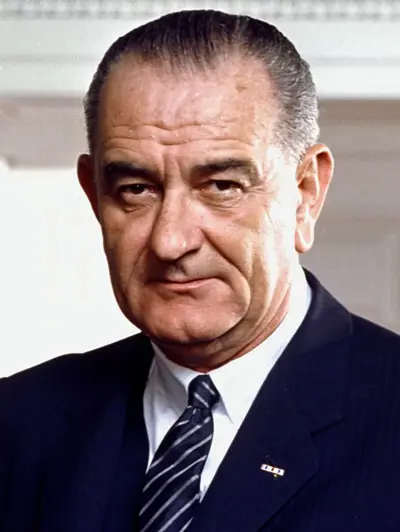
Lyndon Baines Johnson, often referred to by his initials LBJ, was the 36th president of the United States, in office from 1963 to 1969. He served as the 37th vice president from 1961 to 1963 and assumed the presidency following the assassination of President John F. Kennedy. A Democrat from Texas, Johnson was also a United States representative and later majority leader in the United States Senate. Johnson is one of only four people to have served, at various times, in all four federal elected positions.
