Mahatma Gandhi Quotes
For thousands to do to death a few hundreds is no bravery. It is worse than cowardice. It is unworthy of nationalism, of any religion.
Gandhi, Mahatma. The Collected Works of Mahatma Gandhi. Vol. 89, Publications Division, Ministry of Information and Broadcasting, Government of India, 1983, p. 132.


A Cossack revolt had broken out in 1707 and was put down by the Czar’s forces. He then issued what might be one of the first official orders for genocide. Few Cossacks survived.

The Armenian-Turkish enmity was vicious to the point that each people tried to kill and exterminate the other—men women and children. The atrocities committed by the Armenians were unfortunately matched by the Turks in what is now referred to as the “Armenian Genocide”—see {51838} The armed combatants amongst Turks and Armenians were in the minority yet each side slaughtered all members of the other whenever they could. The hatred still prevails – see {588211}. And Turks and Armenians both still accuse the other of atrocities of the period and appear in denial about their own violence.


This is a description of a massacre of Protestants (mostly English) by Catholic Rebels led by Phelim O’Neill. The Catholics whose religion had been compromised when English King Henry VIII severed all ties to the Pope and the Vatican and bound the Irish to that decision of his. The Irish Catholic peasants so resented the English that their hate caused massacres like this in the Irish Rebellion of 1641. Their anger was so great that Phelim O’Neill and his officers lost control of their troops who were bent on revenge.

This argument—that Christians were more cruel and uncivilized than heathens in some respects was very persuasive to many serious white Christians who began to see slavery and the slave trade in a new light.


The Christian Crusaders had captured Jerusalem and slaughtered the Muslim civilian inhabitants. In the 21st century, some Islamic terrorists justified the beheading of captured Christian prisoners as revenge for this massive Christian beheading of Muslims almost 1,000 years earlier.

Jinnah and other Muslim leaders had stirred up the Muslims to violence to put pressure on all the parties to accede to Jinnah's Muslim League's demand of an independent Muslim nation—Pakistan. Messervy was very sympathetic to the Muslim leadership as he had been feuding with and frustrated by the predominantly Hindu ruling Congress Party. After partition he accepted the mercenary position of Commander in Chief of the Pakistani Army. Then he was shocked and horrified at the slaughter of the terrorist attacks by the Muslims—about 4,000 Sikh men, women and children had been beaten and cut to death. The Sikhs had been targeted largely because Sikh leaders had recently announced that if there were a Partition, Sikhs would refuse to live in nation under Muslim control.

The Hun were a very fierce, Asian people who under Attila, defeated the troops of the Roman Empire and sacked several Italian cities. They fought very intensely and terrorized their enemies. The Kaiser came under great criticism from other European powers from urging his soldiers to emulate vicious barbarians with no sense of Christian morality.
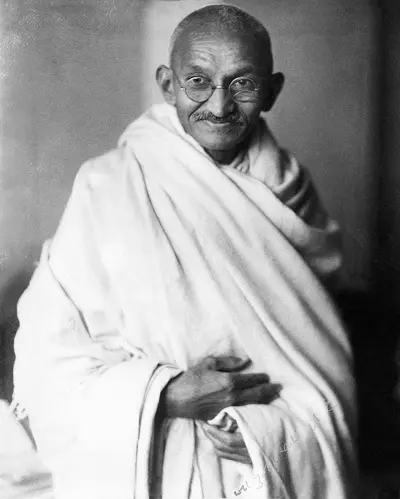
Mohandas Karamchand Gandhi was an Indian lawyer, anti-colonial nationalist, and political ethicist, who employed nonviolent resistance to lead the successful campaign for India's independence from British rule, and in turn inspired movements for civil rights and freedom across the world. The honorific Mahātmā (Sanskrit: "great-souled", "venerable"), first applied to him in 1914 in South Africa, is now used throughout the world.
