Constantine I Quotes
Everywhere Bulgarians had passed, one sees only blood, dishonor and ruin …. It is a refinement of cruelty which the imagination refuses to comprehend.
See Ferdinand I for the Bulgarian denial {601322}.
Constantine I, 1868-1923, King of Greece, Statement at the outbreak of the First Bulgarian War, July 17, 1913
Sourced by: Eigen's Political and Historical Quotations

See Constantine I {598591}

This was part of the continual conflict between the Muslims and the Eastern Orthodox Christians. The Greeks ended up doubling their territory.


The Greeks committed many atrocities in their war with Turkey. See {584483}
First Published American Indian Author. His last public speech. He was referring to a horrible massacre of Christian Indians and the polarizing effect that such conflicts had. Whosoever publicly castigated a massacre of whites or Indians would be met by accusations of condoning the massacres of the other side and ignoring the inevitable and natural seeking of retaliation for future protection and revenge.

The soldiers obeyed their orders and killed every man, woman and child they could find outside the city. They beheaded captured prisoners, bayoneted pregnant women and children. All civilian houses were burned, often with the people trapped inside.

This statement caused great consternation. NcNutt did try to explain that he was speaking personally and not for the Government, but there was a small proportion of America who had concluded that all Japanese should be killed. Such an concept which was unthinkable 5 years earlier was considered as a result of several factors: The Japanese had murdered many American prisoners of war. Killed millions of civilians throughout Asia including doing medical and weapons experiments on live human beings. They had practiced torture, compulsory prostitution and mass rape of conquered territories. At the same time, the Germans had tried to exterminate all the Jews and, with some Japanese help, did kill two-thirds. The concept of genocide had been introduced to Americans as the concentration camps were liberated. And American casualties in the Pacific had been heavy. Vengeance was desired by many. Fortunately, the overwhelming majority of Americans never considered genocide seriously.

The Colonel defined people capable of bearing arms as males and females over 20 years of age. Many were slaughtered. Fortunately, most of his officers and men did not follow this order but enough did to make it one of the most disgraceful events in American military history. Smith was court marshaled and found guilty but his punishment was to be cashiered from the army. There were many atrocities committed by the minorities of both sides in this brutal war. Military and Congressional Investigations caused the army manual to be revised military policies reformed.

The Tanguts were a major Chinese Buddhist culture and people with generations of history, emperors, books and religion. The Mongols had been fighting them for over 20 years. After his death, his army obeyed the order and not only murdered every Tangit they could in the capital city in Western Xia, but razed their buildings, burned their books, destroyed their tombs and artifacts. Tanguts who were in other parts of Western Xia were absorbed and assimilated into the Mongol culture. Even the Tangut language died out in a few generations. The Tanguts had been made to “vanish”.

This quotation distressed many ultra rightists who otherwise were avid followers of Mises. See {632407} for another quotation that distressed many European conservative devotees of Mises.


Saloth Sar Pol Pot. He was responsible for the brutal killing of over 1 million of his own people.

This argument—that Christians were more cruel and uncivilized than heathens in some respects was very persuasive to many serious white Christians who began to see slavery and the slave trade in a new light.

Although a very aggressive military commander, Grant did not approve of proposals to have wars of extermination which many called for against different Native American tribes.


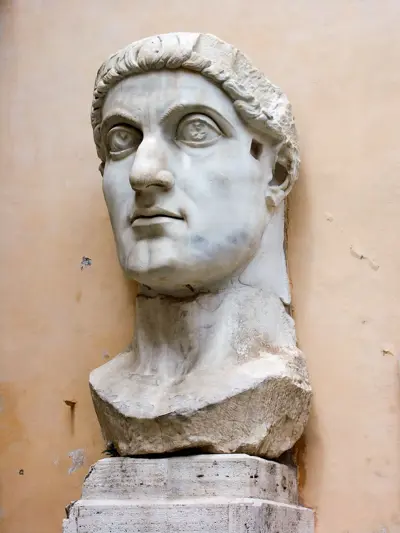
- Born: February 27, 0272
- Died: May 22, 0337
- Nationality:
- Profession:
Constantine I, also known as Constantine the Great, was a Roman emperor from 306 to 337. Born in Naissus, Dacia Mediterranea (now Niš, Serbia), he was the son of Flavius Constantius, a Roman army officer born in Dardania who became one of the four emperors of the Tetrarchy. His mother, Helena, was Greek and of low birth. Constantine served with distinction under emperors Diocletian and Galerius campaigning in the eastern provinces against barbarians and the Persians, before being recalled west in 305 to fight under his father in Britain. After his father's death in 306, Constantine was acclaimed as emperor by the army at Eboracum (York). He emerged victorious in the civil wars against emperors Maxentius and Licinius to become sole ruler of the Roman Empire by 324.
