CONSTANTINE I
(Constantine the Great)
This is one of the earliest views that insane people should not be criminally punished for their acts. To a great extent, Constantine and his contemporaries believed that insanity was the work of the Devil or demons and therefore one should not sympathize with the condition either.
See Ferdinand I for the Bulgarian denial {601322}.
Constantine the Great. Roman Emperors saw Christians as their most dangerous foes. However, Constantine converted to Christianity and ceased the vicious persecution of the Christians. As politicians in many societies need scapegoats to blame for various problems, and the Christians were no longer available, the Jews then became the targeted scapegoats.
Constantine the Great. Roman Emperors saw Christians as their most dangerous foes. However, Constantine, with this edict, enabled Christianity to thrive and grow legally in the Western world. Later Constantine himself converted to Christianity. This edict ceased the vicious Roman persecution that Christians had endured.
“Africa” then meant Northern Africa or what we today call the Middle East. Even in the 4th century it was a hotbed of internecine religious strife. He was not the first to try and cope with the religious strife of Palestine and the rest of the Middle East, and he was certainly not the last.
At the time, there was great debate about Christian theology and most of it was about esoteric and in the Emperor’s view not very important matters. Over a millennium before the Protestant Reformation, there were huge sectarian religious dissents among the Christians. One was on exactly how Easter was to be celebrated, for example.
Constantine the Great
Constantine the Great. This is one of Constantine’s major defenses of his decision to adopt Christianity. Scholars today still argue as to what part practical politics played in Constantine’s conversion and what part was his personal religious conversion.
Constantine the Great
While many think the significance of this quotation lies in the fact that Constantine I accepted Christianity, there is another significant aspect to it. Note the “cruel and miserable” phrase used to describe men being assigned to weave linen. This terror of doing women’s work illustrates the macho chauvinism and sexism of the time. It never occurred to Constantine I or many others, that if doing weaving was not consistent with a state of freedom, then the society had relegated the women to a degrading role where they could weave all day and thus never be free.
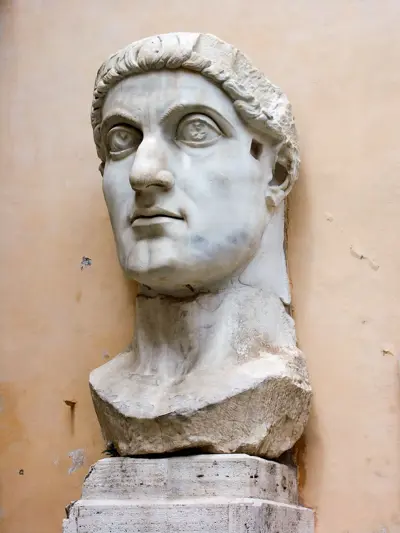
Constantine I, also known as Constantine the Great, was a Roman emperor from 306 to 337. Born in Naissus, Dacia Mediterranea (now Niš, Serbia), he was the son of Flavius Constantius, a Roman army officer born in Dardania who became one of the four emperors of the Tetrarchy. His mother, Helena, was Greek and of low birth. Constantine served with distinction under emperors Diocletian and Galerius campaigning in the eastern provinces against barbarians and the Persians, before being recalled west in 305 to fight under his father in Britain. After his father's death in 306, Constantine was acclaimed as emperor by the army at Eboracum (York). He emerged victorious in the civil wars against emperors Maxentius and Licinius to become sole ruler of the Roman Empire by 324.
