Constantine I Quotes
This is certainly the Will of the Supreme God, who is the Author of this world and its Father … that the whole human race should agree together and be joined in a certain affectionate union by, as it were, a mutual embrace... Let us...my Brothers, follow after the things that are ours, let us walk in the way of the Commandments, let us by good actions keep the Divine Precepts, let us free our life from errors and with the help of the mercy of God, let us direct it along the right path
Constantine the Great
Constantine I, 272–337 57th Emperor of the Roman Empire, Letter from Constantine to the Numidian Bishops, 330
Sourced by: Eigen's Political and Historical Quotations


Constantine the Great. This is one of Constantine’s major defenses of his decision to adopt Christianity. Scholars today still argue as to what part practical politics played in Constantine’s conversion and what part was his personal religious conversion.


See {618216} for a seemingly contradictory quotation by White.


Husayn Ali Nuri. While many religions saw science as a threat or a doctrine that was anti-religious, the Bahai believe that anything that science discovers in the creation of God. Therefore, they have no trouble with Evolution as they believe that this was the pattern that God established.

He was stating for France what the English King James I had said a few decades earlier. See {616307}.


This quotation was used by Aga Kahn III in his famous speech to the League of Nations, October 6, 1937. It speaks of the unity of the Muslims, Jews and Christians from an Islamic scholar of the 13th Century.
al-Mansur Abu Ali. Even though the Caliph was trying to return to Muslim Fundamentalism, there was a general tolerance that was far in advance of Christian societies at the time. It is dramatically at variance with many of the more rigorous Islamic countries today.

Jefferson was a deist but had little love for the organized religions and did not consider the Bible as the revealed word of God.


people for whom transfusions are proscribed Watchtower Bible and Tract Society of New York

Jaroslav Volodymyrovyč ‘Mudryj
The Emperor, who had persecuted many Christians by blinding them was himself going blind from an eye disease. He sought pardon from the Christians and their God. This statement he gave before the Christian bishops.


This is the Islamic version of the Golden Rule.
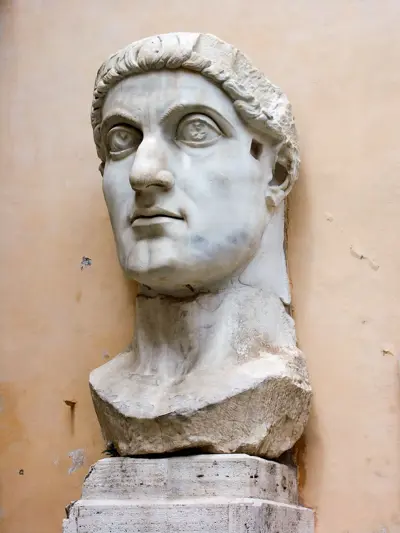
Constantine I, also known as Constantine the Great, was a Roman emperor from 306 to 337. Born in Naissus, Dacia Mediterranea (now Niš, Serbia), he was the son of Flavius Constantius, a Roman army officer born in Dardania who became one of the four emperors of the Tetrarchy. His mother, Helena, was Greek and of low birth. Constantine served with distinction under emperors Diocletian and Galerius campaigning in the eastern provinces against barbarians and the Persians, before being recalled west in 305 to fight under his father in Britain. After his father's death in 306, Constantine was acclaimed as emperor by the army at Eboracum (York). He emerged victorious in the civil wars against emperors Maxentius and Licinius to become sole ruler of the Roman Empire by 324.
