JUSTINIAN I
The Hagia Sophia was the greatest architectural and engineering enterprise of that era and remained so for centuries. The Church was so massive that there was a permanent city of 7000 people on the second level balconies with wide ramps so that horses and carts could go to the upper level. The dome was the largest unsupported dome for centuries and historians are still ignorant of exactly how it was constructed. It changed the history of architecture. The reference to Solomon referred to the building of the original Jewish Temple in Jerusalem which was up to then considered the greatest building ever constructed.
Justinian, like many civil political leaders before and after him, took great pains to minimize the civil authority of the church. Separation of church and state is not a modern notion, though it was harder to accomplish in antiquity. Rulers would want to coopt the religion to help legitimize their rule, but tried to keep the church as weak as they could unless another religion was challenging for supremecy.
The Church was an amazing structure. Ir would be more than 500 years before buildings that size with open areas and large domes could be again constructed. Even today, it is an amazingly beautiful and hugely functional building.
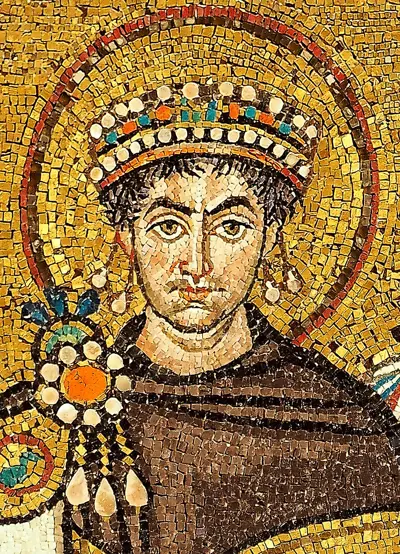
Justinian I, also known as Justinian the Great, was the Byzantine emperor from 527 to 565.
