Constantine I Quotes
To punish madmen is as great folly as to sympathize with their condition
This is one of the earliest views that insane people should not be criminally punished for their acts. To a great extent, Constantine and his contemporaries believed that insanity was the work of the Devil or demons and therefore one should not sympathize with the condition either.
Constantine I, 280-337, Constantine the Great, Roman Emperor, Quoted in Eusebius of Caesarea, Life of Constantine
Sourced by: Eigen's Political and Historical Quotations

This Pennsylvania prison was supposedly a “modern” reform in law enforcement. Rather than work gangs or mandatory factory work, this was the first “penitentiary” in America. The guilty convicts would be in a small cell for all but 1 hour or less a day, and the only thing in the cell other than soap and a toothbrush was a Bible. The convict was supposed to spend his sentence reading th Bible and being penitent for his crimes. It destroyed most inmates mentally until the Supreme Court Ruled total solitary confinement was unconstitutional. There are a fee high security prisons today where there is no social contact allowed the inmates and their constitutionality is being litigated based on Miller’s 1890 opinion. Another point that this quotation illustrates is that sometimes reform efforts produce a situation that was worse than before.


Although this is generally followed as a legal principle in America, states like Texas have executed felons who most other jurisdictions would see as Coke’s “mad man.”


On a tour of America, Dickens visited Eastern State Penitentiary, a Pennsylvania prison opened in 1829 which was supposedly a “modern” reform in law enforcement. Rather than work gangs or mandatory factory work and filthy living conditions, this was the first “penitentiary” in America. The guilty convicts would be in a small clean but bare cell for all but 1 hour or less a day, and the only thing in the cell other than soap and a toothbrush was a Bible. The convict was supposed to spend his entire sentence reading the Bible and being penitent for his crimes. It destroyed most inmates mentally until the Supreme Court ruled in 1890 that total solitary confinement was unconstitutional.

This is an amazingly intellectually advanced quotation. Herman Helcher, was a former pupil of hers who had become mentally deranged and tried to murder her and left her permanently injured. She not only argued against the jailing of a mentally ill person, but she recognized mental illness for what it is—a disease of the brain. This concept was not appreciated by most American politicians or constituents even into the 21st century.


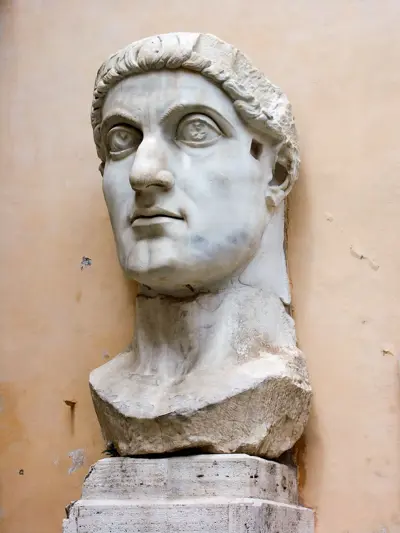
Constantine I, also known as Constantine the Great, was a Roman emperor from 306 to 337. Born in Naissus, Dacia Mediterranea (now Niš, Serbia), he was the son of Flavius Constantius, a Roman army officer born in Dardania who became one of the four emperors of the Tetrarchy. His mother, Helena, was Greek and of low birth. Constantine served with distinction under emperors Diocletian and Galerius campaigning in the eastern provinces against barbarians and the Persians, before being recalled west in 305 to fight under his father in Britain. After his father's death in 306, Constantine was acclaimed as emperor by the army at Eboracum (York). He emerged victorious in the civil wars against emperors Maxentius and Licinius to become sole ruler of the Roman Empire by 324.
