Zachary Taylor Quotes
As to the Constitution and the Union, I have taken an oath to support the one, and I cannot do so without preserving the other, unless I commit perjury, which I certainly don't intend to do. We must cherish the Constitution to the last.
Smith, Elbert B. The Presidencies of Zachary Taylor & Millard Fillmore. University Press of Kansas, 1988, p. 116.

Jackson was reacting to the claimed right of South Carolina to nullify Federal tariffs and other Federal laws.


The Presidential election of 1800 produced a crisis even greater than that of 2000. There was an Electoral College tie between Thomas Jefferson and Aaron Burr—both of the same party, Democratic Republicans. The Federalist Party led by President John Adams had been totally rejected by the voters and Adams was in third place. However, the Federalists saw an opportunity of maintaining the Presidency anyway. The Constitution threw the election into the House of Representatives with each State delegation having a single vote. In the House, the Federalists had parity with Jefferson’s party which resulted in 35 tie votes. Finally, Congressman Bayard, the sole Congressman from Delaware, withheld his vote on the 36th ballot, thereby electing Thomas Jefferson of the opposition party. His reason was:
Soon after Jackson's reelection, delegates from South Carolina, led by John C. Calhoun, moved quickly to declare "null, void, and no law" the Tariff Act of 1832. The president's reaction to the Ordinance of Nullification was swift.

This oath was required of Southern Rebels who wanted obtain amnesty from treason which they had committed by engaging in the Civil War. See {623307} for the Presidential Proclamation.


The president was asked if he supported the Supreme court's school desegregation decision:


The Chief Justice at the time was an ultra-conservative judge, who together with his 8 colleagues—all conservative—had blocked much of the democratic and progressive legislation that the Congress had passed. FDR had a much different legal and philosophical view of the Constitution than the Chief Justice, and the court would declare much of his New Deal legislation, passed in the emergency of the Great Depression, unconstitutional. Almost all of those “unconstitutional” things were years later passed again and this time a more modern court found they were Constitutional.


Abraham Lincoln’s major political opponent in Illinois agreed with Lincoln on the criticality of preserving the Union from a split off of the Southern States. He tended to be more willing to pander to the South than Lincoln, however they were strong allies on the fundamental issue. However, what the slavery forces in the south wanted and needed to forever protect slavery was not in the power of any President to do, short of ending the democracy. Slavery was doomed in the long run if there was no way to enforce the Supreme Court’s Dredd Scott decision upon (Northern) states whose constitutions and laws made any slave who entered the state free and whose people would not use its police and legal powers to return runaway slaves. It was the abolitionists who won the majority in the battle of public opinion on slavery. It was only a matter of time when slavery would become untenable in the South. Lincoln was unwilling to force the Northern states to return fugitive slaves against the constitution, laws and will of the people of those states as Buchanan said he was (but had a hard time doing). Also Lincoln was unwilling to allow new territories to enter the union if they allowed slavery.

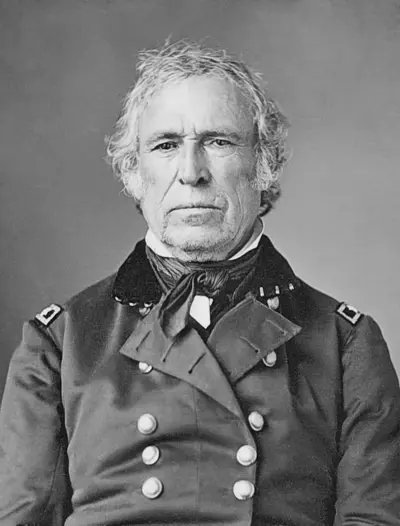
Zachary Taylor was an American military leader who served as the 12th president of the United States from 1849 until his death in 1850. Taylor previously was a career officer in the United States Army, rose to the rank of major general and became a national hero as a result of his victories in the Mexican–American War. As a result, he won election to the White House despite his vague political beliefs. His top priority as president was preserving the Union. He died sixteen months into his term, having made no progress on the most divisive issue in Congress, slavery.
