Dwight D. Eisenhower Quotes
I think it makes no difference whether or not I endorse it. The Constitution is as the Supreme Court interprets it and I must conform to this and do my best to see that it is carried out in this country.
The president was asked if he supported the Supreme court's school desegregation decision:
Dwight D. Eisenhower, 1890-1969, 34th President of the United States (Republican, KS), Supreme Allied Commander in Europe, Quoted in Childs, Eisenhower, Captive Hero
Sourced by: Eigen's Political and Historical Quotations

Cummings was arguing against a Constitutional amendment. His alternative led to Roosevelt's court packing schema.


This concept of balance of power and the equal role of the judiciary is actually quite rare. Even in Parliamentary democracies the parliament can override any court interpretation. In England, the upper legislative house, the House of Lords, actually serves as the nation’s highest or supreme court. And these “Law Lords” can override all regular judicial bodies.


Powell was the Secretary of State and Addington kept advising the administration that as long as the President was acting in defense of the country in his capacity as Commander in Chief, he did not have to obey any existing laws that had been Constitutionally passed which in the opinion of the President restricted or limited the President or the executive branch. Addington was an attorney and Assistant to the Vice President, but he was given much responsibility for administration policy. Powell the Secretary of State of the Administration could not have disagreed more and although most politicians including Republicans disagreed with the Addington thesis, Powell was one of the few Republicans to criticize the Addington position.

The Chief Justice at the time was an ultra-conservative judge, who together with his 8 colleagues—all conservative—had blocked much of the democratic and progressive legislation that the Congress had passed. FDR had a much different legal and philosophical view of the Constitution than the Chief Justice, and the court would declare much of his New Deal legislation, passed in the emergency of the Great Depression, unconstitutional. Almost all of those “unconstitutional” things were years later passed again and this time a more modern court found they were Constitutional.

One of the conundrums of our constitutional system is who has the last word as to what the Constitution means. Essentially it is the judicial branch headed by the Supreme Court. But there are those who believe that the current popular majority should have a say in what is or is not constitutional. If so the legislative branch should have the last word. Still others say that the President is the only person elected by ALL the people, so his opinion most reflects the will of the public. And then there are most who argue that the Constitutional system was created just to avoid the power of currently popular majorities, and the courts should decide based on the Constitution itself. So the statement has very little meaning except that Phillips thinks that the courts have too much power. Whoever gets to decide what is or is not Constitutional will be accused of being “over” the Constitution by those who don’t like the decisions. In our system, that is the courts.


It is argued whether Scalia’s problem was that the Supreme Court was doing something new or radical or the country had changed. He had certainly lived through the greatest transformation of any society and culture on earth at a pace of change that far exceeds anything that has occurred before. Scalia is one who believes that the Constitution should not be interpreted in recognition of these changes, but should be immutable as it was written for the late 18th century. Most judges and legal scholars disagree and try to interpret the Constitution as the founders would have intended, knowing what we know, having the tools and powers we have, and facing the problems of the modern world. It represents a major legal and philosophical debate.

The Presidential election of 1800 produced a crisis even greater than that of 2000. There was an Electoral College tie between Thomas Jefferson and Aaron Burr—both of the same party, Democratic Republicans. The Federalist Party led by President John Adams had been totally rejected by the voters and Adams was in third place. However, the Federalists saw an opportunity of maintaining the Presidency anyway. The Constitution threw the election into the House of Representatives with each State delegation having a single vote. In the House, the Federalists had parity with Jefferson’s party which resulted in 35 tie votes. Finally, Congressman Bayard, the sole Congressman from Delaware, withheld his vote on the 36th ballot, thereby electing Thomas Jefferson of the opposition party. His reason was:


When asked for his position on abortion, candidate Bush answered:. Nine years later, President Bush proposed a constitutional amendment to overturn the Supreme Court's ruling on flag desecration.


See John Marshall's later (1803) use of the concept and term "repugnant." {606483}


This quotation is particularly important because it summarizes one of two opposite schools or thought regarding judicial interpretation of the Constitution that politicians have been arguing about since the Supreme Court first sat. The other is Original Intent where only the original intentions of the writers and ratifiers of the Constitution should be considered—assuming that it can be determined.


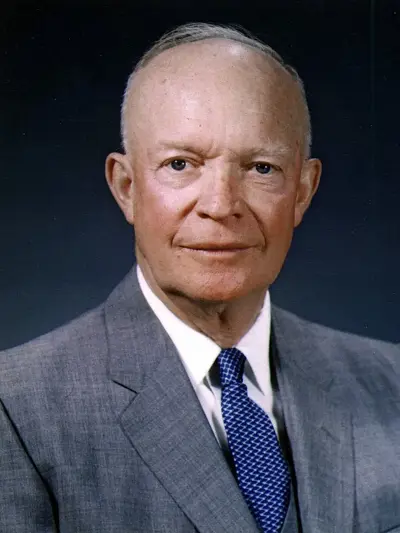
Dwight David "Ike" Eisenhower GCB OM GCS CCLH KC NPk was an American military officer and statesman who served as the 34th president of the United States from 1953 to 1961. During World War II, he became a five-star general in the Army and served as Supreme Commander of the Allied Expeditionary Force in Europe. He was responsible for planning and supervising the invasion of North Africa in Operation Torch in 1942–43 and the successful invasion of Normandy in 1944–45 from the Western Front.
