Alexander the Great Quotes
Your ancestors came to Macedonia and the rest of Hellas and did us great harm, though we had done them no prior injury. I have been appointed leader of the Greeks, and wanting to punish the Persians I have come to Asia, which I have now taken from you.
Alexander and his army were approaching the city of Persian King Darius. The King asked for a truce assuming that a settlement of treasure and land could be worked out as war was usually fought in those days. However, Alexander had led a punitive war where revenge was the major objective. Alexander rejected a truce and chased Darius to his death.
Alexander III (‘The Great’) 356-323 BC, King of Macedonia, Letter to the Persian King Darius, Quoted in Arrian, Anabasis Alexandri
Sourced by: Eigen's Political and Historical Quotations

Ironically, when he attacked Athens in 480 BC, the Athenians under Themistocles, abandoned the city—see {612656}—and lured the overly-confident Xerxes into a sea battle at Salamis where the Persians were totally destroyed. A few public buildings of Athens were burned, but before Xerxes could fulfill his vow, he was defeated and had to retreat to Persia.


Sherman, one of the most gifted generals of the Civil War. He hated the cruelty of war and the Civil War in particular as he had specifically warned his Southern friends ahead of time about what war would bring. See {585882}. Sherman was one of the first American military men to look at war without any of the romantic, patriotic, noble attributes that most others did.

From earliest times, leaders have justified war using religion as the lever to convince the people to fight and pay the other costs of a war. The leaders may have been motivated by hegemony, land, trade and the like but almost always tried to make the war a moral crusade.


This was the day after the Al Qaeda attack on the World Trade Center and the Pentagon, 9-11. Perle, a leading neoconservative advisor and guru, from that day on advocated for the invasion of Iraq. The irony was that at that time, Iraq had never attacked an American, anywhere in the world. Also, there was no Al Qaeda presence in Iraq. Many believe that the neocon main reason to invade Iraq was a regime change and democratization that would, they believed, be a catalyst for democracy throughout the Middle East. The supposed role in 9-11 and the WMD were for them just excuses to initiate military action, so they, the Vice President, and others who agreed with their objective did not question very seriously the so called intelligence about Iraq.

A number of the American soldiers refused to obey Calley's illegal order. Some helped some villagers to escape, and a helicopter pilot landed betreen Callery's men and the villagers they were shooting at, and ordered his helicopter machine gun crew to fire on the soldiers if they did back off. The soldiers stopped firing at the civillians. However, his and other reports of the massacre were covered up by the military for a few years. Mai Lai was not the only major war crime perpetrated by Americans in the Vietnam War; there had been a few others. But given the years of fighting and the many opportunities war crimes violations under orders were quite rare. The Viet Cong had many more war crimes that they perpetrated, and our South Vietnamese allies repeatedly committed war crimes against their own people.

Lee had advised the Southern leadership to avoid secession and the war that would follow. However, the Southern leaders did not really believe that the remainder of the Nation would fight and take casualties to end the institution of slavery. While many would not, they misjudged the intensity of those who would, the moral power of the abolitionists and most Northern religious leaders. Nor did they understand the importance to most Northerners of preserving the Union. And they really had no comprehension of the industrial capability of the Northern free labor states or the importance of that in a long protracted war. Lee, more sophisticated than the other Southern leader, had a more realistic assessment, but thought that there was a chance that the South might have enough early success that the North would politically make the war untenable, but he realized the cost in men and material under the best of circumstances. Lee’s surrender came shortly afterward.


They had seen many other abolitionists attacked and butchered by the pro-slavery forces. The civil war of Kansas was over whether Kansas would enter the Union as a slave state of a free state. If a free state, the free states would be able to block further slavery. If Kansas were to become a slave state, the slave states would have a sufficient majority to make all future expansion hospitable to slavery. The slavery forces started sending man and families into Kansas so that they could vote; the abolitionists did the same. Both sides armed and a war began with each faction trying to kill or drive the other faction out of Kansas before the vote. See {617388} and {612516}.


It is not known what actually happened thereafter. However, from the intensity of this letter, it is likely that unless Rice was killed or wounded in battle, he went to get his daughter and deal with her “owner”. An interesting side note is that the slave owner actually sent the letter to the Commanding Union General Rosecrans complaining. The mental set of Southern Slave Owners was incredible to us today, but that is one of the reasons that Reconstruction was so difficult. Southerners could not see anything that they did that was wrong. Unfortunately, there are a few racist people with those views still in America plus many throughout the world.

Generally after civil wars there have been extensive reprisals and trials of the winning side against the losing one. Lincoln was determined that this pattern not be followed as the bloody war was coming to an end. Ironically, Andrew Johnson, Lincoln’s successor and a Southerner, was, together with some of the Radical Republicans, in favor of trying many of the Southern leaders for treason and rebellion. Lincoln’s view however and that of the moderate members of Congress prevailed. However, the Southern Whites generally would not comply with the Constitutional Amendments and laws regarding the role of the Negro, and Johnson was very sympathetic to their racism which led to a conflict between Johnson and Congress.


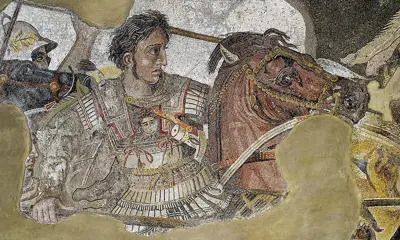
Alexander III of Macedon, commonly known as Alexander the Great, was a king (basileus) of the ancient Greek kingdom of Macedon and a member of the Argead dynasty. He was born in Pella in 356 BC and succeeded his father Philip II to the throne at the age of 20. He spent most of his ruling years on an unprecedented military campaign through Western Asia and Northeastern Africa, and by the age of thirty, he had created one of the largest empires in history, stretching from Greece to northwestern India. He was undefeated in battle and is widely considered one of history's most successful military commanders.
