John Burgoyne Quotes
I will let loose the dogs of hell, Ten thousand Indians, who shall yell And foam and tear, and grin and roar, And drench their moccasins in gore: To these I’ll give full scope and play From Ticonderoga to Florida
John Burgoyne, 1722-1792, British General, Commander of British Troops in the American Revolution, Poem, Burgoyne’s Orderly Book
Sourced by: Eigen's Political and Historical Quotations

Roger’s Rangers of the French & Indian War were the first using unconventional warfare and invented the “deep raid” when they went in stealth all the way to Quebec and defeated the Abnaki Indians in their home village rather than defend against the Indians’ French coordinated attacks on upper York State. Rogers was portrayed by Spencer Tracy in the film Northwest Passage depicting the raid. All the men were killed but the women and children were captured and released with the exception of 5 teenagers who the Rangers took with them. This was one of the first formal “Rules of War” in what was otherwise a viciously uncivilized war.

During the American Revolution, the Iroquois sided with the British, aiding them militarily and other ways. The revolutionaries responded by attacking and destroying most of the Iroquois who retreated to British Canada.

Clark’s men had English Colonel Hamilton under siege by making him think there were many more Americans in Clarks army than the real 180 or so. He tried to get Hamilton to surrender by threatening if they had to take the fort they would treat Hamilton and the British as murderers—Hamilton had paid hostile Indians for American scalps. At that point a party of Clark’s men arrived with 4 or 5 Indian prisoners who had been captured raiding
civilian farms. After the Indians were executed, Hamilton agreed to surrender.


Sherman, one of the most gifted generals of the Civil War. He hated the cruelty of war and the Civil War in particular as he had specifically warned his Southern friends ahead of time about what war would bring. See {585882}. Sherman was one of the first American military men to look at war without any of the romantic, patriotic, noble attributes that most others did.


These battles with the Irish—in this case the MacDonnell clan—were brutal atrocities where the winners of the battle killed all the losers and the women and children with them in the case of the Irish.

This is a very controversial Franklin quotation. In fact, Franklin never sent this letter to Strahan, but it is one of the most famous of the Franklin quotations. It was even famous in 1775. Franklin saw to it that copies of his “letter” reached most American newspaper editors, many of who reprinted it. It was not the first time that an American politician had made quotations for domestic consumption only, and it certainly was not the last. So Franklin never said this to his friend Strahan, but he did claim that he did to all who Americans who would listen. The result is that Franklin developed a reputation for really ‘telling off those Englishmen.’ This was important for him because since he had many friends and admirers in England, he was suspect to many anti-British Americans.


Once blood is shed in a national quarrel, reason and right are swept aside by the rage of angry men.
1st Earl Lloyd-George of Dwyfor

The Belgian soldiers attempted to terrorize and intimidate the natives into working on the rubber plantations. The practice of cutting off hands thus leaving the victim to intimidate others which was so prevalent in Sierra Leone and other parts of Africa in 2000 was also practiced by the Whites at the turn of the last century.


Although a very aggressive military commander, Grant did not approve of proposals to have wars of extermination which many called for against different Native American tribes.

About 2000 Irish were slaughtered while Cromwell only lost 64. In the Irish Rebellion of 1641, many English Protestants—men, women and even children were massacred by Catholic rebels who were out of control of their leadership. See {639336} for an example. Cromwell, when he landed in Ireland with his troops, made no bones about the fact that he was there to avenge the massacres of 1641 {639283} . This was his first “payback”. 150 years later the Irish Protestants memorialize the massacres of the Rebellion of 1641. The Catholics, memorialize, the massacre at Drogheda. Each group uses these and other similar events to justify their positions of antagonism against the other. See {639282} for a moral analysis of Cromwell’s action here.

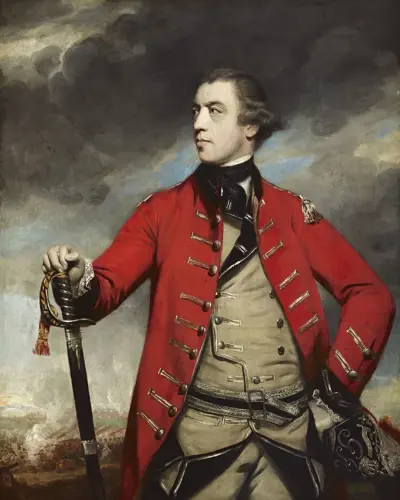
General John Burgoyne was a British army officer, dramatist and politician who sat in the House of Commons from 1761 to 1792. He first saw action during the Seven Years' War when he participated in several battles, most notably during the Portugal Campaign of 1762.
