North China Daily News Quotes
Whoever triumphs, the result of the present upheaval will doubtless be to keep the yoke of militarism as firmly as ever on the neck of the people of China. As Europe has learned to its sorrow, it is possible to win the war and lose the peace, so China is beginning to understand that that blessed word democracy does not mean peace, and that prosperity and order are not necessary corollaries of a successful revolution and a republican form of government.
China, after overthrowing the Manchu Dynasty was struggling among many factions for control of the government.
North China Herald, First English Language Newspaper in Shanghai, Editorial, 1920
Sourced by: Eigen's Political and Historical Quotations


The French Revolution with the rise of Napoleon was a classic example. The American Revolution was an exception.

The Roman Catholic Defender Organization had about 300 thousand volunteers, and Belfast was the central location of the Defender leaders.

She had been asked what she had hoped to accomplish be killing Marat. Of all people Marat had been the most active and vigorous in calling for the beheading of thousands in the French Revolution. It was known as the Reign of Terror.

The Ambassador of Bavaria represented an area where the politicians saw democrats and socialists as their great enemy, as did many of the leading right wing conservatives in all of Germany. They believed that a great war would give them a chance to crush democratic socialism in Europe. Bethmann warned that just the opposite might result, and indeed it did. He was correct. Many of the crowned heads of Europe were deposed and the democratic socialists emerged as a major political factor in the victorious democracies. Bethmann-Hollweg, however, was not a strong leader and could not prevent the Conservatives, the military leaders, and Kaiser Wilhelm from initiating WWI.

The Turkish revolution was by historical standards relatively bloodless as compared especially with other republican revolutions like the United State and France. However, the revolution that brought Ataturk to power was a relatively mild one in terms of the immediate changes that unlike many revolutions which produced instant radical change. In Turkey, the radical change took place in the years after the revolution when Ataturk with hardly any bloodshed produced compulsory public secular education, scientific elevation in society, separation of mosque and state, gender equality including universal voting, change to western dress, elimination of the caliphate, speech and press freedom, and many others including changing the entire language to use the Latin alphabet instead of Arabic. No nation in history has gone thought more social and cultural change and modernized so fast as Turkey after its revolution. The result is the most modern and successful Islamic country in the world.


Young China had toppled the Manchu Dynasty, but once in power, they found it much harder to govern—a common happening after revolution.


With so many revolutionary rulers of new nations suppressing all opposition, the history of Ataturk and Turkey is unique. Ataturk was so popular and his People’s Party so successful that there was no opposition and Turkey had one party rule. However, Ataturk was determined to have Turkey become a parliamentary democracy as good as the Western nations of Europe. So a tradition of multi-party democracy was needed. So Ataturk actually went to his friend Fethi Okyar and asked him to start an opposition party and oppose the government. Fethi was a strong supporter of the revolution and generally was in concurrence with Ataturk and the People’s Party on everything. Ataturk however convinced him that they had to start a tradition that would take Turkey through the future, and he did create a new party-- Serbest Cumhuriyet Fırkası (Liberal Republican Party) and worked hard to find differences with the People’s Party and the Government. One immediate contribution was the oversight that the new party provided—a strong tradition that exists to this day in Turkey.

The Netherlands at that time had a representative republic, but whenever there were troubles, there were many who urged the appointment of a strongman—usually a prince or other noble. In the Dutch republic at the time, de Witt was the Chief Executive, but under their constitution, he could do little without the approval of the parliament. A strong leader with dictatorial powers was called for as there was little experience with a democratic republic and people did not have confidence that governance in a crisis was possible without dictatorial powers lodged in one man. Even in America, there tends to be more power taken by the presidency in time of war and other crises. So the fear and the argument has not changed in almost 400 years.

Early in his career, Santa Anna was an enthusiast for democracy. However, the republican form of government did not work at the time in Mexico and he developed into a despot and dictator.


Helen Keller was a remarkable woman who was blind and deaf, and yet she became a great orator and social reformer.


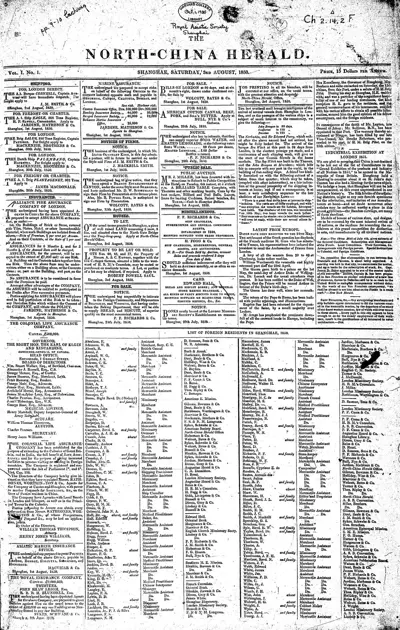
The North China Daily News (in Chinese: Zilin Xibao), was an English-language newspaper in Shanghai, China, called the most influential foreign newspaper of its time.
