Caesar Rodney Quotes
We had carefully to avoid any infringement of the prerogative of the crown and the power of parliament—and yet in duty bound fully to assert the rights and privileges of the colonies.
The Stamp Act had caused much consternation among the colonies. The Continental Congress had gone into session to draft a petition to the King asking that the Act not be enforced. This letter described the chalenge before them. See {589421} for one of the more contentious passages the delegates had to work out.
Caesar Rodney, 1728-1784, Member of the Continental Congress (Delaware), President of Delaware (Title of Chief Official instead of Governor), Letter to his brother, October 20, 1765
Sourced by: Eigen's Political and Historical Quotations

The purpose was to try and get the king and parliament not to enforce the Stamp Act in the colonies. The delegates had to thrash out the language and it was important to flatter the king and parliament. While some delegates felt that loyalty to the mother country, many others thought that the king and parliament had betrayed them and thought this language gross hypocrisy. See {589426} for one delegate’s description of the difficulty.

Some of the Patriots of Early America realized that the oppressions of British rule were coming from Parliament and initially took the position that only the King could make laws for the colonies and not Parliament. Therefore, they were as Englishmen challenging illegal English laws. Most American hostility was directed at Parliament and not the King. However, once there was any physical resistance, King George came down with such a heavy hand that American hatred transferred to him. For related quotes on the King/Parliament issue, see {639145}, {639144}, {639142}, {639141}, {639140}, & {639137}

The colonists in America had no representatives in Parliament. Galloway who opposed armed rebellion against Britain {621966} admitted that the British treatment of America was wrong but saw other solutions. It will never be known if any of them might have worked. The world would have been very different had they been tried.


He was considered Massachusetts’ greatest Colonial orator.

Lee at that time was one of the leaders of the American colonists’ cause. He was born in England and was an old friend of Burgoyne who had just arrived in America. Lee wanted to explain the American viewpoint. Lee later became the senior major general under Washington.

The Governor had warned the Board of Trade about the American reaction to the Stamp Act. He took the position that is was unconstitutional in the sense that it was contrary to Magna Carter. His and other warnings were ignored.

In the English system the checks and balances of the American system are not present. Historically in England the Monarch and the Parliament acted as checks upon each other. With a Constitutional Monarch there is no institutional check on Parliament. The checks are their restraint--respect for precedent--and the voters. The Prime Minister is a member of Parliament and has no powers other than what Parliament gives him/her. The courts in England are under Parliament and the upper house, the House of Lords is the equivalent of the highest court—but it may always be overruled by the parliament itself.

The clergy of the colonies were split on the American Revolution, but those clergy who supported the revolution made a huge contribution to the individual American’s intellectual view of the legitimacy of Parliament’s making laws governing the American Colonies. The anti-British clerics called for action while other forces of colonial America urged caution.

Though not very dramatic or succinct, this is a very important quotation in American History. The original drafters of the Constitution concentrated on limiting the powers of the executive—the role of the King. But the Congress had no limits placed on them. In Britain, to this day, the Parliament can do whatever they wish as there is no restraint on them other than their prudence and reasonableness. Madison used the example of the Alien and Sedition Acts—huge infringements on the rights of Americans—to show why the legislative branch must also be more restrained and limited. And that was the logic behind adding the Bill of Rights to our Constitutions.

The message was conveyed by the Secretary of State, Sir George Calvert (Lord Baltimore). Parliament and the British King were jockeying for position in their relative powers. King James took the position that Parliament could NOT make laws that affected the American Colonies. Parliament disagreed. Later, some of the American patriots would use this quotation to claim that they were only subject to the King and not to Parliament. For related quotes on the King/Parliament issue, see {639144}, {639143}, {639142}, {639141}, {639140}, & {639137}


Burke argued for England giving America much more freedom and self determination. This quotation is, many think, the greatest description of American love of freedom that has ever been verbalized.


This was not quite having representation in Parliament, but the King and the Government would have none of it. We could only speculate on the Americans would have accepted this scheme if it had been offered.


This was one of the first and is considered the best of the Colonial writings against taxation without representation. Despite this, Dulany is not well known in American history because when the Revolution finally came he was a loyalist.
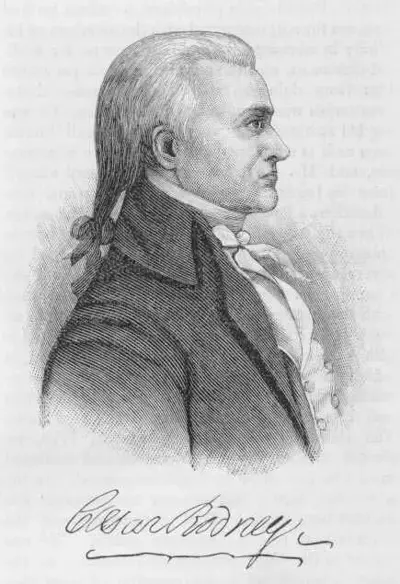
- Born: October 7, 1728
- Died: June 26, 1784
- Nationality:
- Profession:
Caesar Rodney was an American Founding Father, lawyer, and politician from St. Jones Neck in Dover Hundred, Kent County, Delaware. He was an officer of the Delaware militia during the French and Indian War and the American Revolution, a Continental Congressman from Delaware, a signer of the Declaration of Independence, and President of Delaware during most of the American Revolution.
