Continental Congress Quotes
The only representatives of the people of these colonies are persons chosen therein, by themselves; and that no taxes ever have been, or can be constitutionally imposed on them, but by their respective legislatures.
Continental Congress, Number 5, Declaration of Rights, New York October 9, 1765
Sourced by: Eigen's Political and Historical Quotations

The colonists in America had no representatives in Parliament. Galloway who opposed armed rebellion against Britain {621966} admitted that the British treatment of America was wrong but saw other solutions. It will never be known if any of them might have worked. The world would have been very different had they been tried.


This was one of the first elucidations of this principle which became so important for the American union and Revolution. The 1754 debate was over Franklin's public effort for a Colonial Federation (see {37005}, {37006}, & {583424}). Shirley liked the idea but thought that the King of England should appoint the members of a Colonial Congress. This was Franklin's counter, arguing that each colony should elect its own members.


In the struggle for political power, this is often forgotten. During the Barak Administration, the President proposed measures that had been introduced and supported by his Republican opponents earlier. But they then not only failed to support them but often filibustered in the Senate to block them. The Democrats failed to support some of their ideas when President Eisenhower introduced them.


At the time the power and prestige of Congress relative to the Presidency , was much greater than it is today. It was McKinley’s successor, Theodore Roosevelt, who began a 20th century trend which led to a reversal of the relationship between the Executive Branch and the Legislative.

The American Revolution’s ideas spread. This Cahier was the consensus of the Clergy of Blois in 1789. There were cahiers of several provinces of France—some by the clergy, some by the nobles. What is fascinating is the emergence of many of the pre-Revolutionary French concepts. The example of the American revolution and its principles was known throughout the educated classes of France.

This was not quite having representation in Parliament, but the King and the Government would have none of it. We could only speculate on the Americans would have accepted this scheme if it had been offered.

The conservative Senator was very distrustful of the constitutional amendment process itself after a both prohibition and women's suffrage amendments had passed. Wadsworth and his supporters feared Constitutional amendments passed by Congress and the State legislatures without any direct approval of the people.

Many modern Americans who look to the founding fathers for modern guidance regarding gun rights, foreign policy, and many other facets of government are shocked to learn that there was almost unanimous opposition to maintaining a standing army in times of peace. That there was very little concept of military preparedness.

During the early days of the American independence movement, many were preoccupied with the philosophical and theological issues of whether the Almighty approved of monarchy or not. Parker urged concentration on assuring independence first.

Despite his warning---and that of others—all that they could get agreement upon had each of these three weaknesses. After winning the American Revolution, the new country found the Articles of Confederation and the Continental Congress completely inadequate and finally in 1787 there was a Constitutional Convention held in secret in Philadelphia to overcome the weaknesses of the existing structure of which the warnings of Rush were three of the problems that had to be fixed.
In the EU most of the government power is dominated by appointed elites and not elected representatives.
This was the first proposal for a united American government. It provided for a “President-General” and a unicameral “Grand Council” with representation proportional to population.

This is the same man who introduced the Stamp Act 12 years before which started the whole problem in America. See {74956}.

The message was conveyed by the Secretary of State, Sir George Calvert (Lord Baltimore). Parliament and the British King were jockeying for position in their relative powers. King James took the position that Parliament could NOT make laws that affected the American Colonies. Parliament disagreed. Later, some of the American patriots would use this quotation to claim that they were only subject to the King and not to Parliament. For related quotes on the King/Parliament issue, see {639144}, {639143}, {639142}, {639141}, {639140}, & {639137}

This was one of the first and is considered the best of the Colonial writings against taxation without representation. Despite this, Dulany is not well known in American history because when the Revolution finally came he was a loyalist.
This was one of the first and is considered the best of the Colonial writings against taxation without representation. Despite this, Dulany is not well known in American history because when the Revolution finally came he was a loyalist.

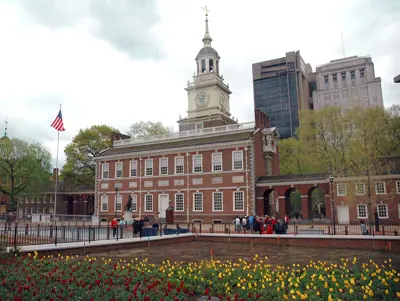
The Continental Congress was a series of legislative bodies which met in the British American colonies and the newly declared United States just before, during, and after the American Revolution. The term "Continental Congress" most specifically refers to the First and Second Congresses of 1774–1781 and may also refer to the Congress of the Confederation of 1781–1789, which operated as the first national government of the United States until being replaced by the current congress. Thus, the term covers the three congressional bodies of the Thirteen Colonies and the new United States that met between 1774 and 1789.
