Mahatma Gandhi Quotes
We deeply deplore the recent acts of lawlessness and violence that have brought utmost disgrace to the fair name of India and the greatest misery to innocent people, irrespective of who were the aggressors and who were the victims. We denounce for all time the use of force to achieve political ends and we call upon all the communities in India, to whatever persuasion they may belong, not only to refrain from all acts of violence and disorder but also to avoid, both in speech and in writing, any incitement to such acts.
With the partition of India forming an independent Pakistan, ethnic riots broke out and millions of people were killed. This joint statement was issued to try and quell the violence but it had progressed too far. Jinnah as a political ploy to obtain the partition organized Muslims and threatened violence—see {627153} and {627169}. Things got out of hand with ethnic cleansing being an objective in many localities—see {627146} and {627149}.
Mohandas K. Gandhi, 1869-1948, Indian Political and Spiritual Leader, Muhammad Ali Jinnah, 1876-1948, Founder of Pakistan and First Governor General, Communique Issued at the Behest of Lord Mountbatten, 1947
Sourced by: Eigen's Political and Historical Quotations

The Muslim League had whipped up and armed Muslims to fight for a separate Islamic state within India. However, instead of revolt or attacks on the Indian officials, things got out of hand and even after they had won the partition of India, the Muslim mobs went on a frenzy and attacked the Hindus and Sikhs in the areas where the Muslims were in the majority. Part of the reason was to intimidate the Indian and British authorities {627153} and the other part was for ethnic cleansing so when there was a partition—Pakistan—the minority Hindus and Sikhs would have converted, been frightened off, of killed. {627149}. Tragically, Hindus and Sikhs retaliated where they were in the majority and no one really knows how many millions of Indians were butchered in the creation of Pakistan.
This quotation is often used as the antithesis of national pluralism. When India was partitioned, there were Muslims and Hindus both who subscribed to this view. The result was vicious interethnic slaughter and ethnic cleansing. However there was a large middle ground who did not accept this monocultural view of a nation. Many millions of Indian Muslims chose to stay in India as minorities and there were 200 million Muslims in India by the beginning of the 21st century. Modern India, is along with the United States, one of the leading ethnic and cultural pluralistic countries in the world. Pakistan was and still is totally monolithic. But it was India where Muslims have much more freedom than there Islamic brothers in Pakistan which although all Islamic constantly has better strife and killings over the degree of orthodoxy the State religion should take.

This do called “Direct Action” resolution was a threat of war. The view of these Muslims was that living in a democracy with a majority of Hindus would be “slavery.” Faced with this intimidation and that of Jinnah {627169} the British agreed to partition India.

Jinnah himself preached non-violence. At the time there was vicious sectarian violence throughout India but especially in The Frontier Province. However, the Muslims of the day did not heed him or Nehru or Gandhi for that matter and the violence continued. Jinnah however was a particularly shrewd politician who successfully used the threat of Muslim violence to obtain a separate Islamic state with Indian independence. He pointed to the threatening resolution issued earlier {627153}. The man who publicly preached peace, privately threatened violence.


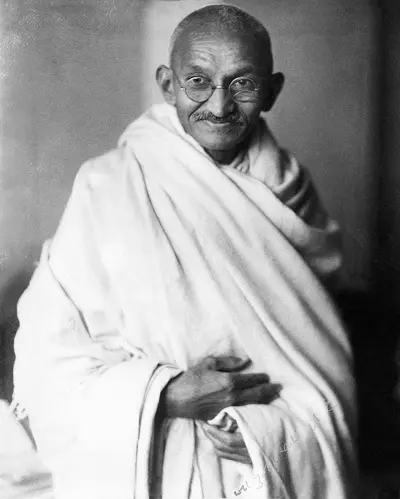
Mohandas Karamchand Gandhi was an Indian lawyer, anti-colonial nationalist, and political ethicist, who employed nonviolent resistance to lead the successful campaign for India's independence from British rule, and in turn inspired movements for civil rights and freedom across the world. The honorific Mahātmā (Sanskrit: "great-souled", "venerable"), first applied to him in 1914 in South Africa, is now used throughout the world.
