Annie Jacobsen Quotes
To understand how black projects began, and how they continue to function today, one must start with the creation of the atomic bomb. The men who ran the Manhattan Project wrote the rules about black operations. The atomic bomb was the mother of all black projects, and it is the parent from which all black operations have sprung.
Jacobsen, Annie. Area 51: An Uncensored History of America's Top Secret Military Base. Little, Brown and Company, 2011.


The article showed how a nuclear bomb worked. The Government attempted to suppress the publication by getting a Federal court injunction. Day and others claimed the article was based on public sources. It was. The U. S. Court of Appeals lifted the injunction and the article was published.

Bethe and other European refugees joined American and British scientists at Los Alamos, NM, for the development of the atomic bomb.

Germany had some world class physicists. Our scientists, military intelligence people, and political leadership assumed that the Germans were also seeking to develop the Atomic Bomb. Ironically, it turned out that they were not, and what Truman reported in this quotation was untrue (although that was not fully known at the time.) Einstein and several of the scientists who were early pioneers in modern physics were Jewish, and Hitler referred to the study of nuclear fission and fusion as “Jewish Science.” As a result, the German government did not commit the resources to the development of an atomic bomb. Instead, they were betting on the development of the Jet Airplane which they succeeded in deploying against the Allies at the end of the war. But they did not have enough or enough pilots left alive to fly them, and Germany was overrun by the Allied Troops. Prior to Truman’s erroneous report about the German development of an atomic bomb, there had only been one piece of evidence that the Germans were not developing one. An OSS secret agent, Moe Berg, had talked with Werner Heisenberg, at a Swiss scientific conference during the war. He was going to assassinate the greatest of the German physicists if Berg thought he was working on a nuclear device. Berg concluded from his discussions that Heisenberg did not know enough about nuclear fission to have been working on that. Berg did not kill Heisenberg, and reported that he did not think the Germans were developing a bomb as if they were Heisenberg would have been deeply involved. However, the American intelligence people and the American scientists, did not trust Berg’s analysis and conclusion. Berg was not a trained scientist. He was a professional baseball player—the NY Yankee backup catcher to Bill Dickey. He was a college graduate, a brilliant guy and a very fast learner who had studied physics books and papers before his assignment. Berg turned out to have been right, but that was not confirmed until a few years after the war. Truman had relied on an incorrect intelligence estimate when he made this quotation. It was not the first such error of intelligence analysis in American history and it would not be the last.


The Scientific Project that developed the Atomic Bomb. Oppenheimer, like most sophisticated intellectuals and scientists of the time had acquaintances who were communists or Communist sympathizer in Oppenheimer's case his brother and wife were both members of communist organizations. They too severed their connections. At the time Russia was on major ally in the war against Hitler and fascism. However since the Communist Revolution of 1917 there had been an animus between the American and Russian governments. The work on the atomic bomb was so secret that everybody was a potential suspect and security risk, even our allies. In the final analysis it was a spy in the Manhattan project who was there as part of the British contribution to the project. The security people were chasing after all the scientists who had friends or acquaintances who were communists and missed the real spy who had no such connections.


Then a Senator and defending the administration's use of an unvouchered Secret Service fund:
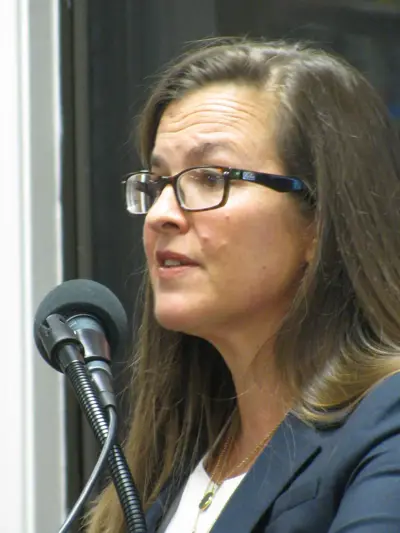
Annie Jacobsen is an American investigative journalist, author, and a 2016 Pulitzer Prize finalist. She was a contributing editor to the Los Angeles Times Magazine from 2009 until 2012. Jacobsen writes about war, weapons, security, and secrets. Jacobsen is best known as the author of the 2011 non-fiction book, Area 51: An Uncensored History of America's Top Secret Military Base, which The New York Times called "cauldron-stirring." She is an internationally acclaimed and sometimes controversial author who, according to one critic, writes sensational books by addressing popular conspiracies.
