J. Robert Oppenheimer Quotes
This nation's defense is at stake. I'm cutting off all my communist connections. For if I don't, the government will find it difficult to use me. I don't want to let anything interfere with my usefulness of the government.
The Scientific Project that developed the Atomic Bomb. Oppenheimer, like most sophisticated intellectuals and scientists of the time had acquaintances who were communists or Communist sympathizer in Oppenheimer's case his brother and wife were both members of communist organizations. They too severed their connections. At the time Russia was on major ally in the war against Hitler and fascism. However since the Communist Revolution of 1917 there had been an animus between the American and Russian governments. The work on the atomic bomb was so secret that everybody was a potential suspect and security risk, even our allies. In the final analysis it was a spy in the Manhattan project who was there as part of the British contribution to the project. The security people were chasing after all the scientists who had friends or acquaintances who were communists and missed the real spy who had no such connections.
J. Robert Oppenheimer, 1904-1967, Physicist and Scientific Director of the Manhattan Project Statement to Arthur Compton, University of California, 1942, Quoted in Jennet Conant, 109 East Palace: Robert Oppenheimer and the Secret City of Los Alamos, 2005
Sourced by: Eigen's Political and Historical Quotations

The security system at Los Alamos while the atomic bomb was being developed was absurd. Scientists from all over the country had to be hired quickly. Many of them had friends and relatives who had various left-wing associations; some came from Germany or had German connections. A number of the key scientists were German refugees from Hitler's persecution. The military security people, using their traditional standards, would not clear people if they had any left wing friends or associates or they came from Europe and there were no records to prove that they were not fascists or communists. Most of the refugees got out with their lives and had no records, but they were among the best scientists in the world. J Robert Oppenheimer, the scientific director, and General Leslie Groves needed the scientists as the work had to be done. Groves approved important personnel for hire pending security clearance which never came and which Groves knew would never come. Nonetheless the people were working by the time intelligence officers outside the project realized what was going on. People without clearance had some of the most sensitive jobs at Los Alamos. Not a single one of those people turned out to be a security risk or a spy. There was a spy however who had come the English scientific delegation, but the security people had cleared him. Barnett however, as Oppenheimer’s personal assistant had access to almost everything having to do with the development of the bomb. She never did get cleared for her job.

The military security people were so used to ferreting out communists in the 1930s that they had a hard time adjusting to the fact that the security risks or people who might have German connections or backgrounds. Many immigrant scientists were recruited for work on the Manhattan project to build the atomic bomb and they only did security clearances. The military security people kept checking on any communist background they might have had as opposed to possible connections with fascist organizations. By the end of the war they had adjusted but then had to go back to looking for communists as the Cold War evolved.
Oppenheimer was cleared but many of the rest of the staff were including those with access to the highest, most critical secrets in the land. See {629854} for a greater understanding of the situation.

After this, no other member of the Executive branch went before McCarthy again


Feynman was then a young brilliant graduate students working with colleagues far senior to him. He not only criticized the lax security of the safes, but when combination safes were later installed, he would infuriate the army security people by “hacking” the safes when scientists had lost their combinations.


This vague criterion was in effect and was initially used to clear scientists at Los Alamos and their spouses who were part of the team that was to develop the Atomic Bomb. The Army security people however had never been in such a situation before. Few distinguished scientists wanted to come to Los Alamos to begin with as once there, they were there for the duration of the war and were cut off from friends and relatives. But there were very few people in the entire country who had the unique education and training. When the security people rejected a candidate before that time, another person was recruited. But for many of the scientists at Los Alamos, they were one of a kind. There were not two Enrico Femi’s or Luis Alverez’s. “Moral fiber” could mean anything and the American academic world has always tolerated a wider variety of behavior then most of the rest of society. Sexual activity, left wing views, parental irresponsibility, failure to pay debts, attacking religion or religious organizations all created problems. But the biggest problem was association with others of “demonstrated weakness in moral fiber” including communists and left wingers. In most university settings, with a norm or tolerance, almost all associated with “undesirables”. As a result many scientists or family members could not get cleared. But the project could not function without them, and if some were fired for that reason, many others might have quit. Finally, General Groves, relaxed the standards, yet the army security officers were constantly suspicious. This criterion was in use as late as the 1960s where a brilliant scientist working in the Executive Office of the President was threatened with dismissal for this reason. She had borne an illegitimate child years earlier.


This quotation illustrates one end of the range of union leadership regarding communism. Some union leader were communists; some were pro Marxist but against the Russian style of dictatorial communism. Others did not care for Communism at all but saw the communists as an effective tool that really frightened American corporate management and politicians so they looked reasonable by comparison and they therefore wanted the communists around. Last were those like Reuther who was aggressively anti-communist and wanted labor to expel them whenever they turn up. However, what is ironic is that Reuther himself was labeled a Communist by many right wingers who also used Reuther’s “duck” test. Reuther wanted a national health insurance system; so did the Communists. He advocated and end to segregation; so did the Communists. He fought for workers having a say in management, a classic communist demand, and many other similarities.


The only soldier ever so honored. He was then the Chief of Staff of the Army.


This point of view is contentious in that many people (usually those at the extreme left and extreme right) think that the intention of the founding fathers was to avoid a single executive from starting a war unilaterally. Congress was given the power to declare war—not the president. Arguably public opinion is reflected by Congress, but going to war, when public opinion has been opposed to it has always turned out badly in American History.


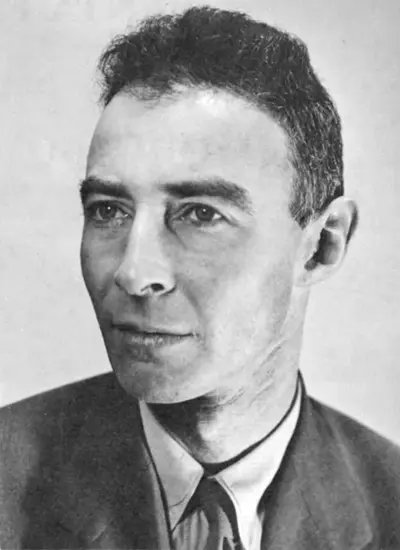
J. Robert Oppenheimer was an American theoretical physicist and professor of physics at the University of California, Berkeley. Oppenheimer was the wartime head of the Los Alamos Laboratory and is among those who are credited with being the "father of the atomic bomb" for their role in the Manhattan Project, the World War II undertaking that developed the first nuclear weapons. The first atomic bomb was successfully detonated on July 16, 1945, in the Trinity test in New Mexico.
