Hans Albrecht Bethe Quotes
In Los Alamos we were motivated by the desire to develop the atomic bomb before the Germans could do it. That was our main motivation …. The Germans surrendered before the bomb was ready and so it was obvious to use it against our remaining enemy [Japan].
Bethe and other European refugees joined American and British scientists at Los Alamos, NM, for the development of the atomic bomb.
Hans Bethe, Nobel Laureate in Physics, Interview, The History Channel, Hiroshima: The Decision to Drop the Bomb, September 14, 2003
Sourced by: Eigen's Political and Historical Quotations


After the Hiroshima bomb there was still no surrender by the Japanese. The decision was made to drop the second bomb on Nagasaki.

There were some doubts the scientists developed after Germany had surrendered as Hitler had been their greatest fear. So they were briefed on the planned invasion of the Japanese mainland and the military medical preparations for treating and caring for ½ million serious wounded casualties. In addition, given the state of war, there was expected about the same number of American Military deaths. On top of that, there would be many more Japanese military casualties plus even more Japanese civilian deaths and wounded. The use of the Atom Bomb would save all those lives but have casualties of its own, but far fewer. At the time, surprising to most people now, the use of the atomic bomb was not an issue of controversy at all. There were no Congressman who questioned it, no newspapers which editorialized against the use of the bomb. There were not even any other counties which protested its use.

Truman had been briefed on the number of Japanese who committed suicide rather than surrender—including civilians—in Saipan, Okinawa, Iwo Jima, and other locations where United States troops had invaded. He and his experts agreed that the Japanese would not surrender unless there was a new dramatic factor that was outside the usual thinking—the atomic bomb. He was proved right about the warning. Not only did the Japanese ignore it, but they did not even surrender after the nuclear devastation at Hiroshima. It took a second bomb dropped on Nagasaki to motivate the surrender. So even a demonstration with all those Japanese casualties did not cause the surrender until it was repeated.


The bombing of Tokyo to which she referred, killed over 100,000 Japanese in a single raid, more than each of the two atomic bombs. However, those who, in hindsight, raise the issue of the morality of using the atomic bombs, say nothing about the firebombing. The graphic is of Dr. Libby when she was working with Enrico Fermi to create the first nuclear chain reaction to prove the feasibility of a nuclear bomb. She was the only female on the team.

See {624449} for the essence of the letter.

Germany had some world class physicists. Our scientists, military intelligence people, and political leadership assumed that the Germans were also seeking to develop the Atomic Bomb. Ironically, it turned out that they were not, and what Truman reported in this quotation was untrue (although that was not fully known at the time.) Einstein and several of the scientists who were early pioneers in modern physics were Jewish, and Hitler referred to the study of nuclear fission and fusion as “Jewish Science.” As a result, the German government did not commit the resources to the development of an atomic bomb. Instead, they were betting on the development of the Jet Airplane which they succeeded in deploying against the Allies at the end of the war. But they did not have enough or enough pilots left alive to fly them, and Germany was overrun by the Allied Troops. Prior to Truman’s erroneous report about the German development of an atomic bomb, there had only been one piece of evidence that the Germans were not developing one. An OSS secret agent, Moe Berg, had talked with Werner Heisenberg, at a Swiss scientific conference during the war. He was going to assassinate the greatest of the German physicists if Berg thought he was working on a nuclear device. Berg concluded from his discussions that Heisenberg did not know enough about nuclear fission to have been working on that. Berg did not kill Heisenberg, and reported that he did not think the Germans were developing a bomb as if they were Heisenberg would have been deeply involved. However, the American intelligence people and the American scientists, did not trust Berg’s analysis and conclusion. Berg was not a trained scientist. He was a professional baseball player—the NY Yankee backup catcher to Bill Dickey. He was a college graduate, a brilliant guy and a very fast learner who had studied physics books and papers before his assignment. Berg turned out to have been right, but that was not confirmed until a few years after the war. Truman had relied on an incorrect intelligence estimate when he made this quotation. It was not the first such error of intelligence analysis in American history and it would not be the last.


The second atomic bomb had just been dropped.
When the American troops invaded Okinawa, the individual Japanese soldiers and civilians would not surrender, even when completely surrounded and out numbered. Surrender was culturally dishonorable and the Japanese had been told by their leadership that if they did surrender the Americans would kill them anyway. Almost all the Japanese died and the United States forces had an astoundingly high casualty rate—37%. Truman was fearful that there might be hundreds of thousands American casualties in the subduing of the Japanese mainland. The atomic bomb solved that problem.

The only soldier ever so honored

The Scientific Project that developed the Atomic Bomb. The focus of the scientists had been to beat the German’s who were terribly evil might develop a bomb first. After the defeat of some scientists began to have concerns about their purpose. Most were very distrustful of the army and believed little of what they were told, by the military at Los Alamos. However, in a remarkable our de force of leadership, Oppenheimer had the trust of virtually all of the staff. This memo and a briefing of the invasion plans of mainland Japan (see {629858} ) convinced the scientist to maintain their intense and punishing pace.


Truman had just told Stalin about the new technology. Stalin had actually already known something about it as the result of Soviet espionage in the United States.

Her critics later started to ask whether the same wise God gave the atomic bomb to the Russians, and to the Pakistanis and the North Koreans.
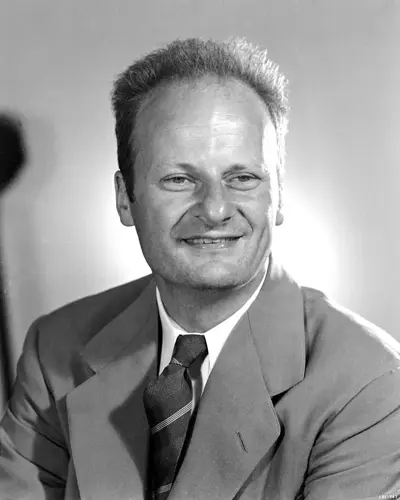
Hans Albrecht Bethe was a German-American nuclear physicist who made important contributions to astrophysics, quantum electrodynamics, and solid-state physics, and who won the 1967 Nobel Prize in Physics for his work on the theory of stellar nucleosynthesis. For most of his career, Bethe was a professor at Cornell University.
