Vannevar Bush Quotes
The atomic bomb means the end of world war.
See {624449} for the essence of the letter.
Vannevar Bush, 1890-1974, Presidential Science Advisor (FDR), Immediate conclusion when he saw Einstein’s letter, Quoted in Wittner, Rebels Against War, Columbia University Press, 1969
Sourced by: Eigen's Political and Historical Quotations

The letter was actually delivered to President Roosevelt on October 11. It was the stimulus for the Manhattan Project to develop the atomic bomb. It had been drafted in large part by physicist Leo Szilard whose idea it was that Einstein sign the letter. As the world’s most prestigious scientist Einstein, Szilard felt, would make more of an impression on FDR than he, Fermi or other scientists even though Einstein was a theoretician and never did work on the development of the bomb. The military men did not understand Szilard and thought him a danger to the nation. So the two men who initiated the idea of the development of an atom bomb did not do any, of the work on it.


The Scientific Project that developed the Atomic Bomb. Oppenheimer was the great physicist who directed the successful development of the atomic bomb so as to build the weapon before Hitler did in World War II. However, as the technology evolved, he had doubts as to the wisdom of creating even more powerful hydrogen weapons. His viewpoint was hurting the administration’s policy of rapid unlimited nuclear weapons development, and he was the victim of a character assassination whereby his security clearance was withdrawn. The “father” of the atomic bomb was the first American casualty of atomic weapons development.

1st Earl Mountbatten of Burma
The Scientific Project that developed the Atomic Bomb


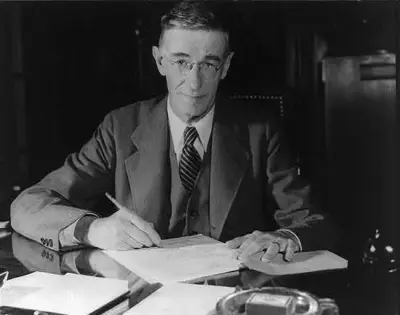
- Born: March 11, 1890
- Died: June 28, 1974
- Nationality: American
- Profession: Scientist
Vannevar Bush was an American engineer, inventor and science administrator, who during World War II headed the U.S. Office of Scientific Research and Development (OSRD), through which almost all wartime military R&D was carried out, including important developments in radar and the initiation and early administration of the Manhattan Project. He emphasized the importance of scientific research to national security and economic well-being, and was chiefly responsible for the movement that led to the creation of the National Science Foundation.
