Roscoe Conkling Quotes
The white men the Democrats of the South are sending to Congress are coming with hands reeking in human gore.
Some had organized and led lynchings; others participated, and others stood by without speaking out.
Roscoe Conkling, 1829-1888, U. S. Congressman & U.S. Senator (Republican, NY), Descriptions of Southern Democrats who supported and were often members of the KKK, the Red-Shirt Riders, and other vigilante violent groups
Sourced by: Eigen's Political and Historical Quotations

Wilson, a history and government professor and college president before politics, was has been accused of being one of the most racist Presidents since Reconstruction. Prior to his Presidency, the Federal Government had been making steady progress in hiring African Americans. Under Wilson there was a wholesale firing of a large proportion of them. Some apologists argue that his League of Nations and other major aspirations required the votes and cooperation of Southern Senators who insisted that many of the blacks be terminated. At the same time, the KKK was near the zenith of its membership and political power and was an intimidating force. Wilson’s home state of New Jersey not only had a large KKK membership but there were lynching of Blacks in his own state and when Governor and President he never asked for any anti-lynching legislation.


The KKK is the oldest of the White Supremicist Hate groups in America. Their self styled mission has been to protect the dominance of the white race. They have, over the years, been responsible for lynchings and other forms of murder and torture. Many Southern politicians in the 20th century were members of this group which in teh first half of the century was a major political force in Souithern States and Indiana. By the end of the 20th century there were almost no politicians who would jion the organization, and the attitude of most politicians, including those from the South, was rather nagetive towards the Klan. However, a few were rather insensitive to the evil nature of the Klan and would make jokes loke this one. Sessions, over his career, had several racist commens that he had made inclding this one. He called an attorney who defended Blacks accused of crimes a race traitor and referred to civil right groups as unAmerican. His appointment as Attorney General by Donald Trump was met with consternation by many biven his history of racial remarks.

For years through the Jim Crow years, Whites murdered many Blacks with impunity if they were perceived to be uppity or to try and obtain their Constitutionally Protected rights. Most took place in the South. The Negroes were typically tortured, mutilated, burned and hung from trees where they would be left for days as the major purpose was to strike terror in the Southern Black population. The Southern State and local governments never opposed the policy via oratory, legislation of law enforcement. The Federal Government did not interfere either. And much of the FBI under J. Edgar Hoover actually enabled the White Citizen’s Councils and the Klu Klux Klan. The NAACP began an anti-lynching campaign and Ms. Holiday was a one-woman public exposure campaign centered around this song. The anthem itself was written by a New York City schoolteacher named Abel Meeropol, using the pen name, Lewis Allan. It reached millions of Americans and Holiday fans the world over. To view some of the historical scenes described in the song, see http://withoutsanctuary.org/main.html

Buying furniture and equipment for Negro schools was perceived by the White Population as “squandering public funds”. Web returned with the Militia but no one would testify against the Klan. Huggins left the area and went to the North. The Klan did not kill him, but they accomplished their objective of intimidating all the local people Black and White so that Negro schools would not be furnished and getting rid of the only White who tried to improve Negro schools. The methods of terrorists have not changed much since then.

Incredible as it seems today, no Black person had ever dined in the White House as a guest of the President. African American servants were common. And Abraham Lincoln had received many Black visitors as had Presidents after him. But no president had ever had a Black person to dine as a social equal. The photo, reproduced here, illustrates the parity. But that was the worst thing a President could do so far as Tillman and his fellow racists were concerned. They had, since the end of the Civil war, used violence and terrorism to murder, maim and/or intimidate the Negro population to remain in an economic and socially inferior position. In Tillman’s state over these decades they had more lynchings than legal executions and there were plenty of them. Newspapers over the South riled up the whites and there was a wave of terror to be sure that the President’s importune action would not be taken as an endorsement of the Negro’s right to any equality or even dignity. This dinner essentially wedded all the Blacks to the Republican Party and all the Southern Whites to the Democratic Party. This would remain the political situation for over 60 years until the Democrats passed the LBJ Civil Rights Act in 1964 and the Republicans decided to solicit the Southern White racists who accepted the invitation and within a few years, there was a complete reversal of party loyalty of most Blacks and most Southern White Racists.


William Z. Foster, the 1928 communist presidential candidate, was arrested because his party’s leaflet contained this “inflammatory” slogan.

This widely publicized statement by Mr. Ethridge was made when he was a member of the President's Committee on Fair Employment Practices during the hearings of this Committee at Birmingham, Alabama.

Named after penal reformer Johne Howard, 1726-1790. Howard Associations have since been organized in many countries.


This quotation illustrates how the racist South defeated the objectives of the Civil War and Reconstruction by the institution of Jim Crowe laws and so called “states’ rights”. It would take more than another half century for the Yankees and the vast majority of the non-Southern Americans decided that the Southerners could no longer “do as they pleased” with fellow human beings. It is hard to believe for us today that an entire section of our country could actually believe in the morality of the South but that is the tragic history of race relations in America.

Historically, until recently there has been a migration from the South to other parts of the country. After legal segregation ended, the out migration slowed and by the end of the 20th century, people—including intellectuals began moving to the South. Generally, the vestiges of the anti intellectualism began to fade, but even into the 21st century the College Board Test Scores and other educational measures were generally lower in the South than in the rest of the country. Ironically, whereas the Southern insistence on segregated schools was to prevent the intellectual erosion that racists thought would come with integration, the educational achievement of the schools and population of the less segregated school areas was considerably better. With legal segregation, there were very few high quality universities in the South and no “World Class” schools. However, along with desegregation has been the intellectual and academic improvement of the Southern Schools and the South began to have, for the first time in America, some educational institutions that were on a par with the rest of the country. The South paid a heavy price for segregation and insularity.


Phelps was a Copperhead Democrat who was a virulent racist, an enemy of Lincoln and supported McClellan against Lincoln in 1864. His extreme disrespect for the President and his racism was not appreciated in Vermont, and Phelps not only failed to help McClellan but destroyed his own credibility in his home state of Vermont. Phelps had been practicing law in New York City where there was a large Copperhead, racist and anti-Lincoln part of the population there.

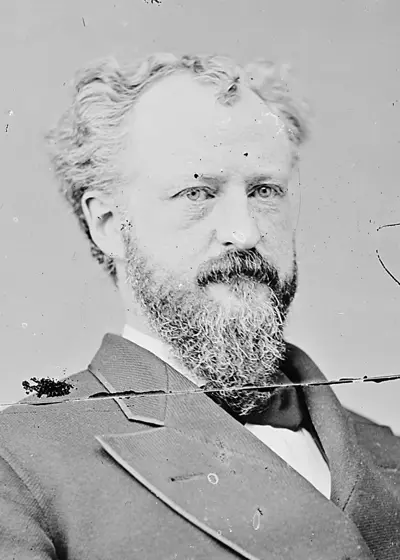
Roscoe Conkling was a lawyer and politician from New York who served both as a member of the United States House of Representatives and the United States Senate. He was the leader of the Stalwart faction of the Republican Party, the first Republican senator from New York to be elected for three terms, and the last person to turn down a U.S. Supreme Court appointment after he had already been confirmed to the post. While in the House, Conkling served as bodyguard for Representative Thaddeus Stevens, a sharp-tongued anti-slavery representative, and fully supported the Republican war effort. Conkling, who was temperate and detested tobacco, was known for his physical condition, maintained through regular exercise and boxing, an unusual devotion for his time. Conkling was elected to the Senate in 1867 as a leading Radical, who supported the rights of African Americans during Reconstruction.
