Rutherford B. Hayes Quotes
The welfare of legitimate business and industry ... will be best promoted by abstaining from all attempts to make radical changes.
Rutherford B. Hayes, 1822-1893, 19th President of the United States (Republican, OH), Message to Congress, 1878
Sourced by: Eigen's Political and Historical Quotations


In 2011 much of the business world complained that they were apprehensive because they did not know how the polarization between the two parties would be resolved. Uncertainty was they felt bad. In this quotation, the president, speaking to business men, assured them that there would be no unexpected changes. His party controlled Congress and fiscally they were very conservative and pro business. Therefore the president could boast that he would not change anything even though the nation was in the midst of a depression. In the 21st century, almost no politician could be successful unless he/she promised to change things. Ironically, within three years, the businessmen of America would be greatly disturbed by change. McKinley was assassinated and Theodore Roosevelt became President and started reforming much of American business from Anti-Trust to government regulation of food. Not all Republicans were committed to no change, and the Roosevelt era was one of great

This statement is very revealing in that it illustrates the attitude of the establishment of most developing nations. Traditional change is OK as long as it is not does transformational—ie as long as it does not make any meaningful changes. But modernization requires transformational change; without it there is no major reform and all institutions and power structures remain in their positions.

This warning was a decade before the Meltdown of 2008, but was not heeded by any of the politicians. As a result a number of the companies that made all those risky decisions assumed that if something went terribly wrong the government would not let them fail. Unfortunately, they were right and the taxpayers spent billions to prevent companies from failing. After the meltdown all the politicians vowed to end the too big to fail concept, but while some improvements were made, the Congress could not come to agreement, and the markets and a number of companies think that they are still too big to fail. This is particularly true for Defense Contractors where the government has and probably will in the future, protect irresponsible companies from failure if they are the only company that makes needed weapons and other equipment.


Compare this quotation with {632899}. Most members of Congress had limited management experience and the only solution to an organizational problem was to fire people. The referenced quotation has people fired for the purpose of inspiring public trust; in this quotation, it is to trigger reform and change. Ironically, there is no evidence in the management literature that suggests that firing for either of these reasons will have the desired objective.

The Meltdown of 2008 and Great Recession that it caused

In 1901, when Theodore Roosevelt became President to Hanna’s chagrin, the new president changed things and went after the must abusive trusts and large corporations.

The result was regulation of the banks and the creation of the SEC to regulate the stock market, However, over the years, the regulations were not able to keep up with the sophisticated development of new forms of investments and financial instruments and the financial industry were able to speculate with other people’s money in ways that FDR and his reformers never imagined. Finally, even the regulation that did exist was weakened by the policies of the George W. Bush administration and the combination brought about the Great Recession of 2008 where the profits from excess speculation were privatized and the losses, socialized with the taxpayer and the American worker bearing the brunt while most of the speculators were bailed out and made more money than ever. The Obama administration tried to reform the situation, but was unable to put an end to the legal speculation with other people’s money or of having institutions that were “too big to fail.”

Greenspan accepted this as many other economists and financial regulators did. What they did not take into account was the incredible greed of many of the financial executive who were betting with their customers money, If the bet was right they, the shareholders and the customers all made out very well as they were highly leveraged. If the bet was wrong, the shareholders and customers lost a lot, and the financial executives only made their multimillion dollar salaries and bonuses (Many were actually were guaranteed their bonuses even if they put the company into bankruptcy.) Worse, they earned their money when they made their sales or earnings targets, but when the securities they bought went sour, even if the company had no funds left, the. It was “heads we all win and tails only I win.” The vested interests between the financial company executives, the shareholders, and the clients were divergent, and the customer was at the bottom of the money pole.
This is the ultimate extreme of conservatism which literally means to conserve what is. Salisbury argues that even if you truly believe that the status quo is bad, you should keep it as the risk of change and unexpected consequence is so great that it is not worth the risk. Interestingly, this is the same mode of thinking which created the command in the Koran for Muslims to live with a terrible Caliph or ruler (unless he is a blasphemer or heretic) rather than risk the instability of regime change. See {590195} and {593076} as examples.


At the time, the economy was virtually controlled by the banks and others in the finance, as opposed to businesses that produced things or provided non-financial services to consumers and business which was that had prevailed ever since the Great Depression, when New Deal legislation controlled the banks, stock markets, and other facets of the financial industry.

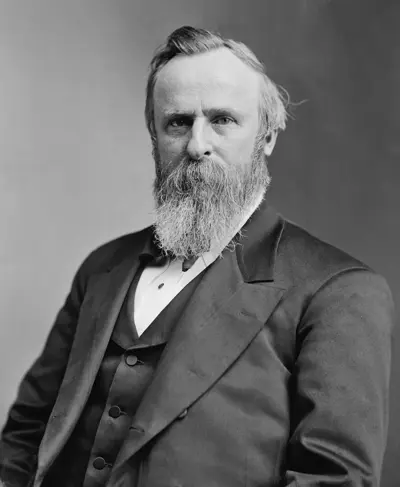
Rutherford Birchard Hayes was an American politician and attorney who served as the 19th president of the United States from 1877 to 1881, after serving in the U.S. House of Representatives and as governor of Ohio. A lawyer and staunch abolitionist, he had defended refugee slaves in court proceedings during the antebellum years. He negotiated the political agreement to end federal support of Reconstruction.
