Hesiod Quotes
The voice of the people is the voice of God.
See Walter Reynolds {32317} for a later English version. Also, Alcuin of York {593018} and William Tecumseh Sherman for an opposite view using a similar phrase. Hesiod's seems to be the earliest version of this idea that is with us today.
Hesiod, 8th century BC. Greek Poet, Works & Days
Sourced by: Eigen's Political and Historical Quotations

This quotation is almost always given as if it were Alcuin who advocated listening to the people, when actually his view was just the opposite. See William Tecumseh Sherman for a more modern expression of the same view. Also, Walter Reynolds {32317} for an opposite view, but using a similar phrase. Note that since he was referring to what "the people" say, the quote must have been in common usage in the 9th century. For the earliest known use of the statement in Western civilization, see Hesiod {603399}.


The speech was never actually delivered, but instead the Bishop published it. It received wide distribution including in America where it was published by the Maryland Gazette on September 29, 1774.


This constitution, 13 years later, became the basis for the national Batavian Constitution.

Bradlaugh was an atheist and refused to take his oath on a Bible or swear to God. He offered to make an affirmation. The issue was debated for 6 years and finally resolved in Bradlaugh’s favor. The right to affirm instead of take a religious oath is now settled American and English law.


His faction won on the House and lost with respect to the Senate.

The State Constitutional ratification convention for Constitutional amendments is


The government relationship to people phrase, although probably Lincoln's most famous, was not totally original. John Adams came close in a 1774 proclamation. As did John Marshall in his McCulloch v. Maryland decision. Daniel Webster's Speech on Foot's Resolution was very close. as was Theodore Parker in 1850 {629578}. There was also Thomas Cooper in 1795. But the earliest appears to be John Wycliffe in 1382 {567292}. It is not known with which of these Lincoln was familiar.
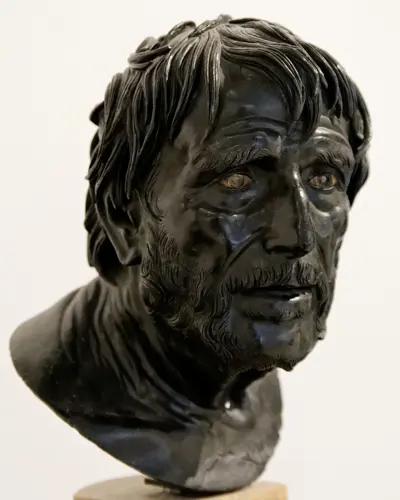
Hesiod (/ˈhiːsiəd, ˈhɛsiəd/; Greek: Ἡσίοδος Hēsíodos, 'he who emits the voice') was an ancient Greek poet generally thought to have been active between 750 and 650 BC, around the same time as Homer. He is generally regarded as the first written poet in the Western tradition to regard himself as an individual persona with an active role to play in his subject. Ancient authors credited Hesiod and Homer with establishing Greek religious customs. Modern scholars refer to him as a major source on Greek mythology, farming techniques, early economic thought, archaic Greek astronomy and ancient time-keeping.
