Calvin Coolidge Quotes
The United States cannot, therefore, fail to view with deep concern any serious threat to stability and constitutional government in Nicaragua tending toward anarchy and jeopardizing American interests, especially if such state of affairs is contributed to or brought about by outside influences or by any foreign power
Calvin Coolidge, 1872-1933, 30th President of the United States (Republican, MA), Message to Congress, 1926
Sourced by: Eigen's Political and Historical Quotations


The Congress was reacting against the prospect of France supporting a monarchy in Mexico.

There are some authorities who believe that this quotation was apocryphal as it is not in any of Roosevelt’s official papers. However, many of his remarks were not. This was before the digital age were almost everything a President says is recorded. Most authorities believe it to be an actual quotation, and we have included it with the caution that some take a contrary view. It certainly was what FDR thought about Somoza, and the pragmatism of a close alliance with a useful dictator was typical of Roosevelt who presided over our WWII alliance with Joseph Stalin whose soldiers and civilians bore the great brunt of the German Nazi fighting.


This was his political speech about the importance of the state militia. However, in the War of 1812 in September the British attacked and burned the town of Portland which the militia feebly tried to defend. See his private view then: {613332}.


In Chile’s first Democratic election, to the chagrin of our Ambassador Korry and others in the U. S. Government, an avowed Socialist, Allende, was chosen by the people. Korry and others then stopped any U. S. Aid and did what they could to have the Allende Administration. However, Henry Kissinger and the CIA did not want to wait for economic sanctions to work. Keeping our Ambassador in the dark, they helped the right wing Chilean Military organize a coup to remove Allende. Allende committed suicide rather than be captured by General Pinochet and other military who commonly tortured political enemies and killing many. The result was an end to socialism, but the cost was tens of thousands of Chileans, murdered, tortured and disappeared by Pinochet and his forces. Pinochet was finally convicted of war crimes and crimes against humanity.

The 40 Committee was a secret committee of officials to deal with major national security covert operations possibilities. Chile had democratically elected Salvador Allende, a strong socialist, as President. He then, as he had promised in his campaign, begun to nationalize mining and other heavy industry and nationalized the very large farms. Kissinger and some others thought that Allende might probably transform Chile to communist state. The committee was discussing whether or not the United States should, via covert operations, try and destabilize or overthrow the Allende government. There was a strong minority aristocracy of the wealthy who would definitely support such an activity. Kissinger argued for intervention and some others observed that Allende had been fairly elected as a leftist by the people. Kissinger made this famous statement, and America covertly though the CIA worked with the Chilean right wing and fascists to overthrow Allende. The military, having been given the “green light” started attacking the Presidential Palace. Allende made a radio speech to the nation. A few hours later, the military seized the palace and reported that Allende had committed suicide.
Kissinger stating that the US should “correct” the election “mistakes” of other countries was of course Top Secret and the official US position was to support the right of any people to elect their preferred leaders. Normally, the public would never have seen the transcript of the meeting until many decades had passed but part of the transcript found their way to a manuscript of a book about the CIA. That agency went to the courts to block the publication and Kissinger’s statement. However, although the quote was removed from the book, enough people had now seen it, and the quote was leaked.
The quote is historically important for the real story of what really happened in Chile as General Pinochet who seized power turned out to be guilty of Crimes Against Humanity and Allende is today a national hero and martyr. In addition, it is a wonderful example of “overclassification”. After the action was completed, why should the American Public not know that its Secretary of State did not believe in democratic elections if the people would elect communists? --especially when the official stated policy he was presenting was just the opposite. The argument faded when the Watergate Scandal broke and consumed America’s attention.


The Mexicans had to agree to whatever terms the United States demanded. President Polk wanted to annex California and the New Mexico territory (included Arizona) as well as other territory including Baja—a territory much larger than Western Europe. Trist watered down the demand and only included California and the New Mexico territory.
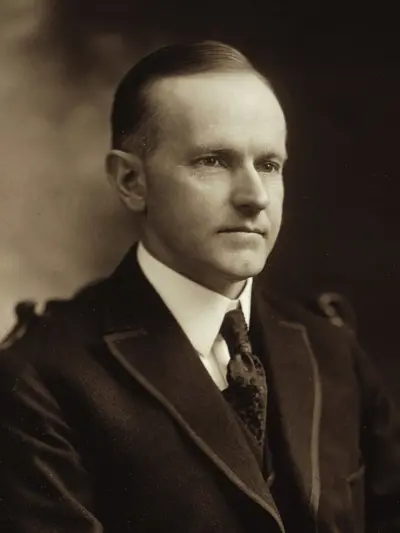
Calvin Coolidge was an American lawyer and politician who served as the 30th president of the United States from 1923 to 1929. A Republican lawyer from New England, born in Vermont, Coolidge worked his way up the ladder of Massachusetts state politics, eventually becoming governor of Massachusetts. His response to the Boston Police Strike of 1919 thrust him into the national spotlight and gave him a reputation as a man of decisive action. The next year, he was elected the 29th vice president of the United States, and he succeeded to the presidency upon the sudden death of Warren G. Harding in 1923. Elected in his own right in 1924, he gained a reputation as a small-government conservative and also as a man who said very little and had a rather dry sense of humor.
