John Negroponte Quotes
I think people took Grenada for what it turned out to be, which was a very specific incident and from which one couldn't necessarily make a lot of generalizations.
Negroponte, John. Interview. CNN Cold War, Episode 18: "Backyard", Cable News Network, 1998.


The Mexicans had to agree to whatever terms the United States demanded. President Polk wanted to annex California and the New Mexico territory (included Arizona) as well as other territory including Baja—a territory much larger than Western Europe. Trist watered down the demand and only included California and the New Mexico territory.


Despite a policy of non-intervention in the affairs of other countries, America has frequently found a reason to make an exception to the policy and send troops to a foreign nation to shape the government in a direction to our liking. After WWII America also used covert operations to change regimes or destabilize governments perceived not in America’s interests. Sending troops to Western Hemisphere nations was continued as well but much less frequently than earlier.

What makes this quotation important is that the Central Intelligence Agency disobeyed the order and implemented a number of covert operations in Indonesia and CIA Director Alan Dulles did not tell the President. See {634612} for his rationale.


sending American troops to Vietnam


The Congressman was being critical of the George W. Bush Administration and their tendency to decide which leaders and countries were legitimate and moral and which were not, and then invading the “bad” and executing the leaders as with Iraq and Saddam Hussein.

Misha Saakashvili, the President of Georgia, the ex-Soviet State, had a good bit of support in American political circles and decided to start a military conflict with Russia attacking a disputed area whose people had rejected Georgia and preferred the Russian affiliation and control. He was confident that the US would protect him from major retaliation. The Russians first moved troops into the attacked area and then started attacking Georgia military assets. Rice and the Russian Foreign minister were negotiating a cease fire on which they agreed to details and were going to impose them on Georgia. However, Lavrov demanded that Georgia President Saakashvili be deposed. Either nation had the power to do this, and both had in many past instances deposed or overthrown the leaders of other nations—democratically elected or not. This quote is very interesting because in this particular case the United States was stating its idealistic policy and not its “real-politic: that it exhibited in helping to bring down and depose democratically elected in Iran, Chile, Vietnam, Venezuela, Haiti, and others. Ironically, there were many in the US who wanted Saakashvili deposed for unilaterally starting a military conflict Russia that had to involve the U. S.

Hoover and most Republicans were generally opposed to sanctions and an instrument of foreign policy. 25 years after his presidency, the Republican Party started embracing sanctions as a tool of foreign policy and by the end of the 20th century, Republicans were sanction hawks. This quotation illustrates how American political parties and their philosophies change over time.

The quotation is notable as it illustrates the great difficulty that modern democracies have with extreme Islamic fundamentalists. Their very perception and world view is so different that often we think of the extremists as insane and they often feel the same way about us.

Nasser was indeed planning an attack. Israeli intelligence had discovered it, and the Israeli’s informed President Lyndon Johnson who in turn called Kosygin. Nasser and the Arabs had miscalculated again and ended up being not only defeated in the war they wanted but totally embarrassed by the incredibly poor performance of the Arab armies who greatly outnumbered the Israelis but had no stomach for a fight.

The plan was to have an American agent with a few marines make an alliance with a rival to the throne of Algiers and depose the existing ruler with American “special forces”.

The “proofs” were diplomatic assurances—treaties—that England would guarantee the territorial integrity of Belgium. The British made strong diplomatic efforts to persuade Germany not to occupy Belgium. The German’s none the less send armies in under the excuse that if they did not, the French would occupy the country and have a strategic advantage over them. Diplomacy could do no more good. England had to send troops or renege on its obligations. So England was in WWI.

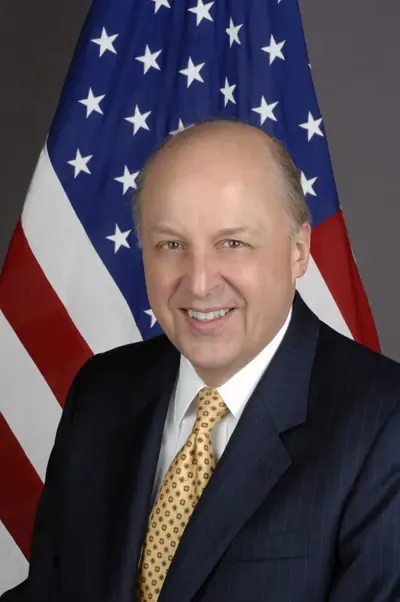
John Dimitri Negroponte is an American diplomat. He is currently a James R. Schlesinger Distinguished Professor at the Miller Center for Public Affairs at the University of Virginia. He is a former J.B. and Maurice C. Shapiro Professor of International Affairs at the George Washington University's Elliott School of International Affairs. Prior to this appointment, he served as a research fellow and lecturer in international affairs at Yale University's Jackson Institute for Global Affairs, United States Deputy Secretary of State (2007–2009), and the first ever Director of National Intelligence (2005–2007).
