Dwight D. Eisenhower Quotes
No Americans may be involved in any operations partaking of a military character in Indonesia
What makes this quotation important is that the Central Intelligence Agency disobeyed the order and implemented a number of covert operations in Indonesia and CIA Director Alan Dulles did not tell the President. See {634612} for his rationale.
Dwight D. Eisenhower, 1890-1969, 34th President of the United States (Republican KS), Executive Order, 1958
Sourced by: Eigen's Political and Historical Quotations

This is a major issue for the nation. How can the president be responsible if he is not informed? However, some argue that the President must have “plausibility deniability” so he can deceive foreign leaders without lying to them. The laws require that nothing may be withheld from the President but there are some in the agency including past directors who believe that they sometimes should lie to the President or withhold information when it is in the national interest—which of course only they judge without any checks and balances.


Dulles lied to Congress. The CIA at the time was supplying planes and American pilots in support of an anti-Sukarno Government faction that was in armed revolt. It is not clear whether or not Dulles knew the truth when he had so testified.

The Congressman was being critical of the George W. Bush Administration and their tendency to decide which leaders and countries were legitimate and moral and which were not, and then invading the “bad” and executing the leaders as with Iraq and Saddam Hussein.


Ironically, Lieberman was using this quotation to campaign against Bush’s son, George W. Bush.


This is a variant of a famous Clauswitz quotation {635143}.


Holland was then a Republic and federation of the separate states. Each elected representatives to the ruling legislature, however, many states had not been pleased that their representatives did not reflect the desires and public opinion in the individual states and in some cases took bribes to vote in favor of special interests. The Dutch did NOT want their representatives to use their own judgment but wanted them to seek and follow the instructions of the legislatures of each state.

This is a very important historical and political quotation. First, notice that the Secretary of State was criticizing the policies of his President, a refreshingly honest statement, but one which would never be made after the 1950s. The criticism was not even mild but very heavy. A political opponent could not be more negative. Next consider that while the Secretary of State and almost all the experienced diplomats thought the President foolishly wrong and naive about the practicality of self-determination, by the end of the 20th century, virtually every country in the world, capitalist, communist, secular or religious, wealthy or impoverished, all see self-determination is a basic right of all nations. The President was on the right side of history and all the professional diplomats on most nations were on the wrong side. However, Secretary of Lansing was right about one thing. The quest for self-determination has caused a fearful toll of human lives—not thousands as Lansing predicted but millions. He was also right about another aspect—namely that the unit of self-determination can be confusing and contentious. For example, the French Canadians of Quebec want a great deal of self determination and autonomy, but they do not want to give the same right of self-determination to the Mohawk Indians in Quebec who want to govern themselves. There is a continuous dispute in Turkey where the Kurds claim the right of self-determination within Turkey. Turkey has literally dozens of minority groups. Does self-determination mean that each can have its own nation within what is Turkey. And what about the Native Americans in the United States? Nonetheless, Wilson’s general principle is approved by all while the details are often contentious.

The Vietnam War was certainly not a victory for the U. S. Some saw it as our first defeat. While it was not ended on Johnson’s watch, he must certainly share that responsibility with Nixon and even JFK as these three all were responsible for our Vietnam failure. Johnson, ended up with what he feared most.

The plan was to have an American agent with a few marines make an alliance with a rival to the throne of Algiers and depose the existing ruler with American “special forces”.


Charles Wilkes, a Union Navy Captain enforcing the naval blockade of the South, intercepted a British mail ship in the Caribbean and discovered two Confederate diplomats on board. He took them into custody to the cheers of Congress. England, however, was outraged that passengers—diplomats—on one of their ships was seized after boarding. This was technically an act of war. Abraham Lincoln, to the distress of many in Congress ordered the Confederate diplomats released explaining with this quotation.

While to Madison the principle that “war is better than tribute” was “settled policy”, there were many who disagreed. See {640867} as an example.

Although Great Britain had abolished slavery, British economic interests during the Civil War suffered because of the northern blockade of the South. Much political opinion in England was hostile to the blockade policies of the Union. Bright, a great admirer and supporter of the United Sates and the Union cause was concerned that the United States might drift into War with Great Britain. His letter to Senator Sumner was written with the understanding that it would be in shared with President Lincoln, and it was actually read at a cabinet meeting.

The “proofs” were diplomatic assurances—treaties—that England would guarantee the territorial integrity of Belgium. The British made strong diplomatic efforts to persuade Germany not to occupy Belgium. The German’s none the less send armies in under the excuse that if they did not, the French would occupy the country and have a strategic advantage over them. Diplomacy could do no more good. England had to send troops or renege on its obligations. So England was in WWI.

The Dutch Monarch William V, Prince of Orange, was in a very precarious position and might be deposed. Officially Harris and the British were supporting him and Harris was giving him money to firm up his regime, but their great fear was that the French would support and control the Patriot Revolutionary movement, then quite active or even intervene militarily to aid the Patriots.


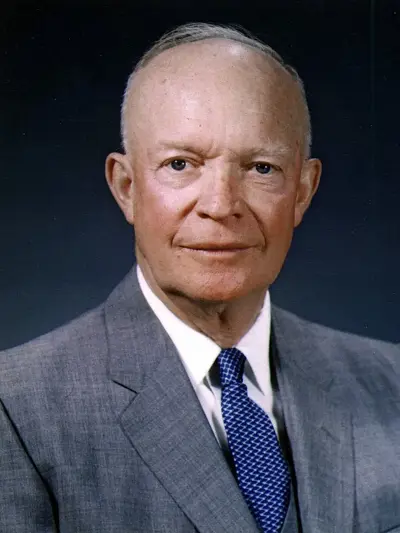
- Born: October 14, 1890
- Died: March 28, 1969
- Nationality: American
- Profession: President
Dwight David "Ike" Eisenhower GCB OM GCS CCLH KC NPk was an American military officer and statesman who served as the 34th president of the United States from 1953 to 1961. During World War II, he became a five-star general in the Army and served as Supreme Commander of the Allied Expeditionary Force in Europe. He was responsible for planning and supervising the invasion of North Africa in Operation Torch in 1942–43 and the successful invasion of Normandy in 1944–45 from the Western Front.
