Calvin Coolidge Quotes
The public wants a solemn ass as a President. And I think I'll go along with them.
Also attributed earlier to Thomas Corwin. See under "Memorials"
Calvin Coolidge, 1872-1933, 30th President of the United States (Republican, MA), Remark to Ethel Barrymore
Sourced by: Eigen's Political and Historical Quotations

McGovern partisans were hostile to the Congressman in his own home district:


He believes that the best way to achieve that is to achieve that is to increased of eliminate campaign contribution limits. Bopp however is at odds with many leading Republicans over transparency which he supports. Others want secret and anonymous contributions.


As Vice President, George W. Bush represented the U. S. at the funerals of many foreign dignitaries:


Compare this quotation with {632907}. Most members of Congress had limited management experience and the only solution to an organizational problem was to fire people. The referenced quotation has people fired to trigger reform and change; in this quotation, it is for the purpose of inspiring public trust. Ironically, there is no evidence in the management literature that suggests that firing for either of these reasons will have the desired objective.

Ronald Reagan was then very successful in politics and a master of television.


This is one of the more candid and honest description of the reality of a new Presidential Administration making the transition from the old administration.
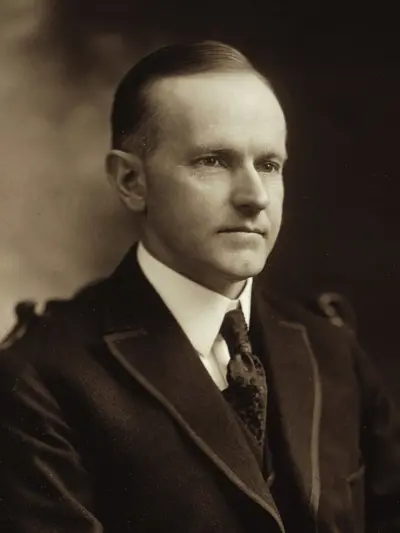
Calvin Coolidge was an American lawyer and politician who served as the 30th president of the United States from 1923 to 1929. A Republican lawyer from New England, born in Vermont, Coolidge worked his way up the ladder of Massachusetts state politics, eventually becoming governor of Massachusetts. His response to the Boston Police Strike of 1919 thrust him into the national spotlight and gave him a reputation as a man of decisive action. The next year, he was elected the 29th vice president of the United States, and he succeeded to the presidency upon the sudden death of Warren G. Harding in 1923. Elected in his own right in 1924, he gained a reputation as a small-government conservative and also as a man who said very little and had a rather dry sense of humor.
