Bill Clinton Quotes
The best technology transfer program is that of MIT. The reason is that they do not take any money for licensing. Instead they take stock. Then they make professors available to the company
William Clinton, 42nd President of the United States (Democrat, AR), Presentation, New York City Historical Society, November 8, 2011
Sourced by: Eigen's Political and Historical Quotations


Industrial spying and trade secret thefts are very common in the South Korean business culture. Bribery of competitor’s employees is common. In the pre WWII period of Japanese control, the Japanese had a policy of keeping Korea technically backward to produce food cheaply and trade the food to Japan and buy manufactured goods from Japan—a classic colonial strategy. Japanese engineers and other technicians would go to Korea set up facilities but never share their knowledge with the Koreans. If technicians were needed, they would have to come from Japan. None the less there is a cultural blindness and Korean firms will commonly steal technology from anyone—partners or others. The South Korean Governments had looked at this with a blind eye. Many Koreans believe that because of past history the only way that they can survive on world competition is to continue to pilfer technology. However, modern South Korea has excellent technicians and scientists in almost all fields and making the cultural shift to a standard that is more consonant with the majority of the industrial democracies is the great challenge.


Even before being an independent country, America had two contrasting and contradictory views of patents—the one that Franklin herein states and the one what was written into the constitution that argued that by granting patents inventors would be incentivized to make their trade secrets public if they had an exclusive monopoly on if for a period of time. Both of these philosophies towards patents have coexisted since then. There was a Federal patent system for those who wanted to use it, and for those who did not, they could enter the invention to the public domain as Franklin urged. Arguably, we have obtained the best of both approaches. Millions of patents have been filed and granted and yet some of the most important inventions have followed the Franklin approach. See the quotes about the Salk Polio Vaccine—{29154} and {29187} and the quote on "open source" computer software—{29676}. With billions of dollars being made by protected software in the early 21st century, over half of the world's computers were operating on systems that was public domain and without charge as just one large example of the Franklin philosophy still coexisting.

If we do not have more scientific graduates from the university we will lose contact with modernity.
One of his major initiatives was to reform the Italian university curriculum to have more scientific offerings. Italy historically has been a great scientific culture ranging from Galileo to Enrico Fermi, but in recent times the universities have not had strong scientific curricula.

This seemingly beneficial objective began to develop serious opponents as Google began to index more and more of the knowledge of the society. Vested copyright interests, scholars, civil libertarians, privacy advocates, and forces in control of information all discovered consequences.

This has been true for a long time. The United States in its colonial days and its early days of independence stole huge amounts, especially from England. The Lowells stealing the technology and machines for weaving cloth from English companies is one dramatic example. Another is the fact that we did not recognize the copyright laws until the middle of the 19th century. American publishers, including Benjamin Franklin, stole most of the material they published. Thomas Jefferson was a foe of government protection of intellectual property—{605105}.


Drucker probably underestimated the importance of both the credentialing role of universities.


This quotation is an excellent statement of one major viewpoint about patents. However there are others who disagree and many who believe the existing patent system is broken and inhibits innovation. They observe that the vast majority of patents never are developed or reach the public. They also point to major counter-examples to Thomson’s view. The best is the PC which IBM developed and decided NOT to patent it, to encourage people to produce programs, applications and many devices. No product in human history has been more thoroughly developed and adopted by as many people as quickly. More capital investment money has been invested that any other invention. There are many examples where Thompson’s point holds. Vaccines for which there is no patent have not obtained any company who would manufacture it despite the need. The issue is complex with the old view of Thomson certainly not correct, but not entirely wrong either.

Stallman and others opposed copywriting of software and felt that computer programs were ideas and as such should not be able to be legally monopolized but they had to live with the law as it was. They started the open source software movement where many programmers developed software and made it freely available to the world. However, there were many companies who would take the free software which was very good, package it with their own brand and sell it. Stallman then created the copyleft concept. This meant that the open source programmers legally copyrighted the program and then created a license that anyone could have for free. But the license only gave them the right to use the software or give it freely to others. Charging money would be a copyright violation. So he and many others since used the copyright law to prevent others from interfering with or making money from distribution and Stallman named it “copyleft” meaning the other side of copyright. Thousands of major programs have been distributed this way. In some areas. It has been so successful that the free software became much more widely used than the products of Microsoft, Oracle or any of the other commercial software developers. Website development has become an example. Not only do many use it because the price is right but much of the open source free software is the best of breed. The Obama White House used a copyleft, free program for the White House website, not because they would save money—the Clinton White House had already licensed excellent commercial software. They chose the open source Drupal package because they thought it was the best available at any price.

One major purpose of the patent system is to get inventors to disclose their inventions and explain how they work and in exchange they get a temporary monopoly to profit from the invention. That is why all patents are available to the public so that science can advance if all other see how something was done. Despite the Douglas View, gadgets have been patented if they had some novel element to their functioning.
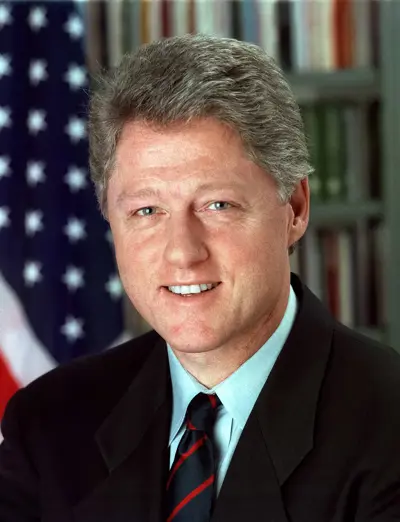
William Jefferson "Bill" Clinton is an American politician who was the 42nd President of the United States from 1993 to 2001. Clinton was previously Governor of Arkansas from 1979 to 1981 and 1983 to 1992, and the Arkansas Attorney General from 1977 to 1979. Clinton was born William Jefferson Blythe III – he changed to his stepfather's name at age 15.
