William E. Gladstone Quotes
… that wealthy, intelligent, and energetic portion of the Irish community which predominates in Ulster.
The belief in the “superiority” of Northern Ireland was also held by the Conservatives. See Arthur James Balfour.
William E. Gladstone, 1809-1898, British Prime Minister (Liberal), Speech to Parliament introducing the Irish Home Rule Bill, June 7, 1886
Sourced by: Eigen's Political and Historical Quotations

1st Earl of Balfour. Balfour was arguing against a united Ireland having autonomy whereby the wealthier, more Protestant, Northern Ireland would be dominated by Southern Ireland. See his political opponent, William E. Gladstone, for a similar view of the “superiority” of Northern Ireland.


Craig’s bias against Catholics was so great that it never occurred to him that he was addressing a Catholic Prime Minister.


First Irish Bishop in the United States and the First Catholic Cardinal of New York. Moscow had just been burned by the French. No New York Catholic churches were harmed.


Having endured centuries of near slavery and discrimination, 70,000 Irish people signed this petition urging American-Irish immigrants to understand the similar plight of African-Americans and to join together with abolitionists. Irish immigrants were nevertheless reluctant to join the abolition movement because the movement was often tied to anti-Catholicism and many feared that the emancipation of Blacks would increase competition for the low-paying jobs immigrants held.

He lost be 2 votes.

The founders were all Irish Protestants. Yet in their initial charter, they called for proportional representation of Roman-Catholics. Not all the relations between Irish Catholic and Protestants were hostile. There was a commonality in their Irish nationality and many protestants—especially the educated and more sophisticated—were opposed to the restrictions imposed by England on the rights of the Roman Catholic to practice their religion or participate in government. See {639279} for another example.


SNCC had been formed to promote equality, but race and class were the issues, not gender. Many of the women left SNCC and proceeded separately to start a women’s movement.

Prime Minister William Pitt, Edmond Burke, and Irish Patriot Henry Grattan had met with the king to discuss granting Irish Catholics rights to participate in government. The King was quite bigoted against Catholics, but England was at war on the continent and if Irish Catholics were angry enough, they might conspire with the Catholic French for an invasion of Ireland. When the Protestant members of the Dublin Corporation heard about the meeting, they immediately issued their own resolution to the King recommending the continued discrimination against Catholics. In a huge political battle in the English Parliament, Pitt and Burke were able to make some progress. The Penal Laws against Catholics that had been in force for a century were repealed. And Catholic men in Ireland were given the right to vote for members of the Irish Parliament. However, the Conservative Protestants blocked further reforms and Catholics were still not allowed to sit in Parliament of hold public office. Between this quotation and {639274} we see the Irish Protestants somewhat divided with the liberals wanting to give Catholics political equality and the Conservatives opposed.

Wesley had been to Island several times and was interested in affairs there. He was a strong advocate of freedom of religion but the violence of the earlier religious conflict made him very wary of the Irish Roman Catholics who seemed to him particularly prone to religious violence.


Could not be priests, friars, or deacons. In addition, Englishmen were prohibited from playing hurling, a wonderful Irish type of rough field hockey which is still the traditional Irish sport but played only in Ireland and New York (by the Irish immigrants). The Irish were considered an inferior culture and race in the concept of the time. See {639438}. The similarity of the prejudice of the English against the Irish parallels very closely that or the Southern American whites against the Negroes.

Protestant ascendancy was the policy of keeping Protestants dominant while allowing Catholics to worship but to be politically, socially, and economically subservient to the Protestants.

This quotation explains why so many of the Southern poor so actively supported the racist Slavery system even though they could not afford slaves and received no direct benefit from slavery or the discrimination against free Blacks. The poor were not at the bottom of the totem pole, and therefore had a dignity and social status, that the poor in a racially integrated society never possessed.
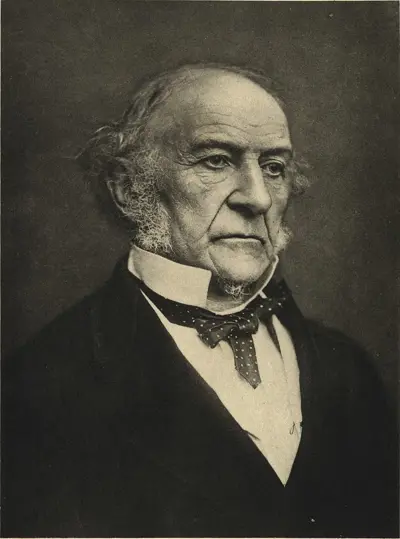
William Ewart Gladstone FRS FSS was a British statesman and Liberal politician. In a career lasting over 60 years, he served for 12 years as Prime Minister of the United Kingdom, spread over four terms beginning in 1868 and ending in 1894. He also served as Chancellor of the Exchequer four times, serving over 12 years.
