Society of United Irishmen Quotes
In the present great area of era of reform, where unjust governments are falling in every quarter of Europe … when all government is acknowledged to originate from the people … we think it is our duty, as Irishmen, to come forward and state what we feel to be our heavy grievance, and what we know to be its effectual remedy. WE HAVE NO NATIONAL GOVERNMENT—We are ruled by Englishmen and the Servants of Englishmen …. [We seek] AN EQUAL REPRESENTATION OF ALL THE PEOPLE IN PARLIAMENT… No reform is practicable, efficacious, or just which does not include Irishman of every religious persuasion.
The founders were all Irish Protestants. Yet in their initial charter, they called for proportional representation of Roman-Catholics. Not all the relations between Irish Catholic and Protestants were hostile. There was a commonality in their Irish nationality and many protestants—especially the educated and more sophisticated—were opposed to the restrictions imposed by England on the rights of the Roman Catholic to practice their religion or participate in government. See {639279} for another example.
Society of United Irishmen, Irish Political & Social Reform Society, Founding Charter, October 14, 1791
Sourced by: Eigen's Political and Historical Quotations

Prime Minister William Pitt, Edmond Burke, and Irish Patriot Henry Grattan had met with the king to discuss granting Irish Catholics rights to participate in government. The King was quite bigoted against Catholics, but England was at war on the continent and if Irish Catholics were angry enough, they might conspire with the Catholic French for an invasion of Ireland. When the Protestant members of the Dublin Corporation heard about the meeting, they immediately issued their own resolution to the King recommending the continued discrimination against Catholics. In a huge political battle in the English Parliament, Pitt and Burke were able to make some progress. The Penal Laws against Catholics that had been in force for a century were repealed. And Catholic men in Ireland were given the right to vote for members of the Irish Parliament. However, the Conservative Protestants blocked further reforms and Catholics were still not allowed to sit in Parliament of hold public office. Between this quotation and {639274} we see the Irish Protestants somewhat divided with the liberals wanting to give Catholics political equality and the Conservatives opposed.

Not all the relations between Irish Catholic and Protestants were hostile. There was a commonality in their Irish nationality and many protestants—especially the educated and more sophisticated—were opposed to the restrictions imposed by England on the rights of the Roman Catholic to practice their religion. See {639274} for another example.


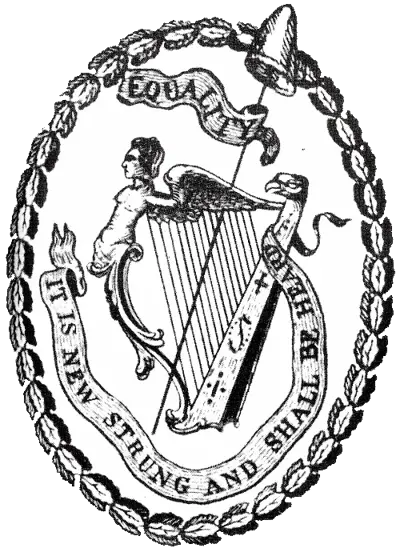
The Society of United Irishmen, also simply known as the United Irishmen, were a sworn society in the Kingdom of Ireland formed in the wake of the French Revolution to secure "an equal representation of all the people" in a "national government." Despairing of constitutional reform, in 1798 the Society instigated a republican insurrection in defiance of British Crown forces and of Irish sectarian division. Their suppression was a prelude to the abolition of the Protestant Ascendancy Parliament in Dublin and to Ireland's incorporation in a United Kingdom with Great Britain.
