William McKinley Quotes
[Referring to Cuba:] I speak not of forcible annexation, for that cannot be thought of. That by our code of morality would be criminal aggression.
William McKinley, 1843-1901, 25th President of the United States (Republican, OH), Message to Congress, December, 1897
Sourced by: Eigen's Political and Historical Quotations

In that year Republican President William McKinley reversed Cleveland’s policy against expansionism at the expense of independent peoples. He staved off annexation while he was president because of his views as early as 1893. See {643147}.

England in this quotation claims the right to interfere in the internal affairs of another nation if there is mismanagement or crises AND her national interests are affected.

There were some anti-war forces in Germany in World War I.

The slavery issue was the dominant issue in pre-Civil War America. It even drove foreign policy.
Cuba has been in American sights for a long time.


The vice president did not heed his own warning and was one of the major forces starting the Iraq war to take down the Saddam Hussein government.


This statement became known as "The Truman Doctrine." Truman asked for $400 million to help Greece and Turkey fight stave off armed Communist minorities destabilizing their governments.

The “proofs” were diplomatic assurances—treaties—that England would guarantee the territorial integrity of Belgium. The British made strong diplomatic efforts to persuade Germany not to occupy Belgium. The German’s none the less send armies in under the excuse that if they did not, the French would occupy the country and have a strategic advantage over them. Diplomacy could do no more good. England had to send troops or renege on its obligations. So England was in WWI.
It was true that the majority of the citizens of Crimea in 2014 preferred to be a part of Russia than the Ukraine. So the Russians sized the Crimea, had an election and when the vast majority of the Crimeans voted for Russian affiliation, they annexed the Crimea under the principle of self-determination. However, Russia has two of its states with Muslim majorities that prefer to affiliate with one of the majority Muslim nations in the area. But the hypocrisy of the Russians became clear when they would not allow those two states to have elections. The Russian policy seemed to be that whatever is part of Russia is non-negotiable and not subject to self-determination, but whatever borders on Russia that is not part of Russia is entitled to an expression of self-determination and independence of other affiliation if they want. The Crimea had the only warm water port in the Soviet Union; they had a deal with the Ukrainians that their navy could use the port. However, they felt that Western support for the new Ukrainian government was the first step in ousting Russia from that port.


The Treaty with Spain ending the Spanish American War was up for Senate Ratification. But the treaty gave the Philippines to the United States, and anti-imperialist Senators balking at ratifying the Treaty.


The United States did very little to stop the Armenian genocide that had been carried out by Turkey. We also did little to stop the Nazi genocide of the Jews and Gypsies, the extermination of the Cambodian urban and intellectual population and the Ruanda genocide of the Tutsies. The argument that we could not stop it tended to mean that we did little or nothing to diminish the murder. President Clinton stated that this failure was his greatest mistake in office.

The Mexicans had to agree to whatever terms the United States demanded. President Polk wanted to annex California and the New Mexico territory (included Arizona) as well as other territory including Baja—a territory much larger than Western Europe. Trist watered down the demand and only included California and the New Mexico territory.


In 1908 Austria had designs on the Balkans, whose small countries have been fought over for years.

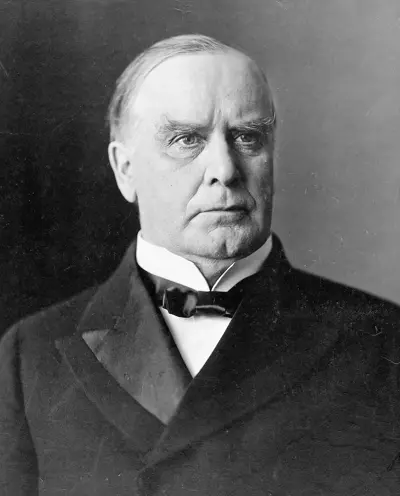
William McKinley was the 25th president of the United States, serving from 1897 until his assassination in 1901. McKinley was president during the Spanish–American War of 1898, raised protective tariffs to boost American industry, and rejected the expansionary monetary policy of free silver, keeping the nation on the gold standard.
