Maximilien Robespierre Quotes
Now, a river of blood will divide France from its enemies.
Maximilien Robespierre, 17 September 1793, after his Committee of Public Safety passed the Law of Suspects which allowed them to arrest and execute anyone suspected of harbouring anti-revolutionary views
Sourced by: Eigen's Political and Historical Quotations


Prior to whites settling in America, various Indian tribes had a long history of fierce fighting for control of Kentucky. The Transylvania Land company negotiated for the “rights” to Kentucky. Dragging Canoe, who opposed the treaty, argued that the land had a bad history and would be very difficult to settle. Poet Theodore O’Hara described Kentuckians as “Sons of the Dark and Bloody Ground” in his poem, The Bivouac of the Dead.

She had been asked what she had hoped to accomplish be killing Marat. Of all people Marat had been the most active and vigorous in calling for the beheading of thousands in the French Revolution. It was known as the Reign of Terror.


Many of the French Revolutionists viewed the French Revolution as only the first step in a European revolution where all monarchies in Europe would be overthrown and popular rule installed throughout the continent. This obviously made the crowned heads of Europe and their governments very nervous. Other French Revolutionaries however, wanted to assure the rest of Europe that the revolution was only a French affair so that they should not send troops to overthrow the French Revolution. See {585773} for a foreign policy type statement. It is probable that Warville’s desire was shared by most French revolutionary leaders but they were more circumspect in their public and official statements.


He was then a young Lieutenant.


Ellsworth was pleading for resolving the slavery issue then.
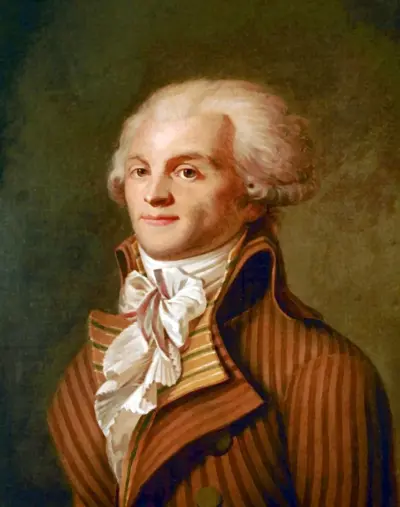
Maximilien François Marie Isidore de Robespierre was a French lawyer and statesman who was one of the best-known and most influential figures of the French Revolution. As a member of the Constituent Assembly and the Jacobin Club, he campaigned for universal manhood suffrage and the abolition both of celibacy for the clergy, and slavery. In 1791, Robespierre became an outspoken advocate for the citizens without a political voice, for their unrestricted admission to the National Guard, to public offices, and for the right to carry arms in self-defence. Robespierre played an important part in the agitation which brought about the fall of the French monarchy on 10 August 1792 and the summoning of a National Convention. His goal was to create a one and indivisible France, equality before the law, to abolish prerogatives and to defend the principles of direct democracy.
