Joan of Arc Quotes
King of England, render account to the King of Heaven of your royal blood. Return the keys of all the good cities which you have seized, to the Maid. She is sent by God to reclaim the royal blood, and is fully prepared to make peace, if you will give her satisfaction; that is, you must render justice, and pay back all that you have taken….King of England, if you do not do these things, I am the commander of the military; and in whatever place I shall find your men in France, I will make them flee the country, whether they wish to or not; and if they will not obey, the Maid will have them all killed
She referred to herself and others referred to her as “The Maid of Orleans” and she wrote of herself in the third person.
Joan of Arc, 1412-1431, French Military Heroine & Roman Catholic Saint, Letter to the King of England, March 22, 1429
Sourced by: Eigen's Political and Historical Quotations

Campbell carried out the order although many MacDonalds escaped in the highlands. The particular massacre has always taken on an even greater infamy because the Campbell murderers had been given food and hospitality by the MacDonalds. This began the most bitter of the Scottish clan feuds that persists into modern times.


This letter was written at the request of Rotrou the Archbishop of Rouen with the urging of King Henry II. Eleanor, one of the wealthiest and powerful people in Europe of either sex, left her husband and sided with one of their sons in a feud with the father, King Henry. Henry and most of the English and French courts wanted her to return to her husband and this letter was meant to chastise her behavior. She however, paid it no heed. The law of scripture to which Peter referred is a passage in the Book of Ephesians—see {618995}

It was the common practice in France to allow citizens to work in various occupations only if they received Royal permission. Some obtained monopolies in certain trades for certain areas. This is an excellent case of a reform which completely reversed previous policies. The authority doing the reform takes credit for it ignoring that the abuses and evils that it corrected were operated and maintained by them also. This quotation was also used in arguing the Slaughterhouse Cases before the Supreme Court in 1873.

The revolution turned on many of its initiators including Vergniaud. He was guillotined along with other Girondists.


The moral imperative of submission rather than allowing a war started by the aggressor, logical for Pizarro and Church leaders of the time, is the same logic of aggressors from Adolf Hitler to Saddam Hussein.

Ataturk was a young major at the time commanding troops of a weak and corrupt Ottoman regime. However a combined English and French (the strongest military powers in Europe) invasion of the Gallipoli Peninsula threatened to capture the Turkish capital, Constantinople. Ataturk alone rallied the Turkish defenders and fought the invaders to a standoff in long drawn out battle with huge casualties on both sides. Ataturk became a national hero. Although Ataturk thereafter was very reluctant to use military force or endanger troops, the thing he always thought worth the supreme sacrifice (including his own) was the independence and sovereignty of the nation. See {584502} for his continuing belief in this type of sacrifice.

The Lebanese Prime Minister had been assassinated with most Lebanese thinking that the Syrians were behind the murder. All the political parties in Lebanon called for a UN Tribunal to investigate the assassination. As the Tribunal was ending its investigation, word leaked out that the report would name Lebanese Hezbollah operatives as being involved in the assassination. If that happened, the Lebanese government and army would have the obligation to arrest the murders for trial and Lebanon would be split against Hezbollah which was the most powerful and militant political group as well as being a terrorist group. Hezbollah declared that they would not allow any arrests of their people, and that they wanted the Government, led by the murdered politicians son to repudiate the UN Tribunal even before the report was issued. When that failed, Hezbollah withdrew from the government coalition and reconstituted a government without the son of the murdered Prime Minister who was then thrown out of office. Jumblatt’s Druze party held the balance of power and surprisingly sided with Hezbollah. Usually he was a strong advocate for justice. However, if he refused to go along with Hezbollah, they would use their terror troops against the Lebanese army and civil war would result. Hence Jumblat’s answer—a classic statement of a political dilemma.


As a slave holder himself, this was a dramatic statement. Slavery was immoral, God’s justice will not be on the white slave owners side, a slave revolt or other event could occur and change things radically. One great puzzlement of American history has been why Jefferson, who wrote so eloquently against slavery and predicted the disaster that would come. would himself keep his slaves and never free them as George Washington did. Some argue that he was so broke financially, that he could not afford to free them.

The Dutch Monarch William V, Prince of Orange, was in a very precarious position and might be deposed. Officially Harris and the British were supporting him and Harris was giving him money to firm up his regime, but their great fear was that the French would support and control the Patriot Revolutionary movement, then quite active or even intervene militarily to aid the Patriots.

This was the point of view that was adopted by the Western Allies about the German Nazis and collaborators in the other European nations. However, not everyone agreed at the time with this policy. Lord Russell, the British Nuremburg Prosecutor resigned over this policy. He had case files against over 100,000 Nazi’s who had committed war crimes that he was not allowed to pursue. There was one Western county that did not follow this policy—Norway. They actually tried, convicted and jailed 10 percent of their entire population for collaboration. Their rehabilitation was just fine without the services of these criminals and they became the richest per capita country in the West including the U.S. The issue will be debated by historians of each generation.


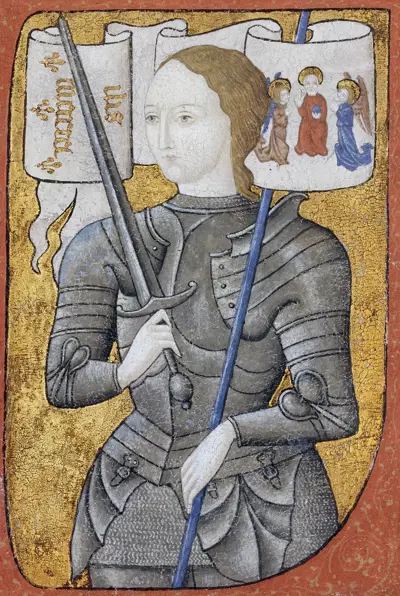
Joan of Arc, nicknamed "The Maid of Orléans" (French: La Pucelle d'Orléans) or "Maid of Lorraine" (French: La Pucelle de Lorraine), is considered a heroine of France for her role during the Lancastrian phase of the Hundred Years' War, and was canonized as a saint. She was born to Jacques d'Arc and Isabelle Romée, a peasant family, at Domrémy in the Vosges of northeast France. Joan said that she received visions of the archangel Michael, Saint Margaret, and Saint Catherine of Alexandria instructing her to support Charles VII and recover France from English domination late in the Hundred Years' War. The as-yet-unanointed King Charles VII sent Joan to the siege of Orléans as part of a relief army. She gained prominence after the siege was lifted only nine days later. Several additional swift victories led to Charles VII's consecration at Reims. This long-awaited event boosted French morale and paved the way for the final French victory at Castillon in 1453.
