Mustafa Kemal Ataturk Quotes
I am not ordering you to fight for your country. I am ordering you to die for your country!
Ataturk was a young major at the time commanding troops of a weak and corrupt Ottoman regime. However a combined English and French (the strongest military powers in Europe) invasion of the Gallipoli Peninsula threatened to capture the Turkish capital, Constantinople. Ataturk alone rallied the Turkish defenders and fought the invaders to a standoff in long drawn out battle with huge casualties on both sides. Ataturk became a national hero. Although Ataturk thereafter was very reluctant to use military force or endanger troops, the thing he always thought worth the supreme sacrifice (including his own) was the independence and sovereignty of the nation. See {584502} for his continuing belief in this type of sacrifice.
Kemal Ataturk, 1881-1938, 1st President and founder of the Turkish Republic, Speech to his troops at the Battle of Gallipoli, 1915
Sourced by: Eigen's Political and Historical Quotations

Ataturk had been a military hero, but was very much opposed to war and military adventurism not unlike the Dwight Eisenhower and Colin Powell type leaders. However, the one thing that he thought worth the sacrifice of his own and other Turkish lives was Turkish independence and sovereignty. Historically, the Ottoman Empire which Ataturk finally ended, had dominated half of Europe and all of the Mid East at the cost of sovereignty of other nations and Ataturk saw no more important virtue with dying for than national sovereignty. See {125322} and {584501}.


3rd Earl Russell of Kingston

Quintus Horatius Flaccus


Joseph Addison had earlier written of such a situation. Recent research has strongly suggested that Hale may never have said these words. The American patriots wanted to have heroes and may not have been too worried about the documentation and historical research. See {621112}

Even as he was being executed for his many war crimes, the Field Marshal exhibited the mental perspective of Germanic patriotism that had brought Europe as well as Germany itself so much death and ruin.

A Federal Naval flotilla was preparing to attack South Carolina Forts Beauregard and Walker in the area of Hilton Head and Port Royal. The navy took both forts the next day with their naval bombardment so powerful that the Confederate Rebels had to abandon both forts gaining a kind of revenge for the Confederate capture of Fort Sumter at the war’s beginning.

The first two lines of the song became the slogan a few years later of veterans of the Normandy invasion of WWII.


Compare Nathan Hale's last words.

An example of this was the landing in the beaches of Normandy in WWII. Once on the beaches the allied troops had to win or die. Some of the most heroic fighting in American and English military history occurred on those beaches. Another was the Spanish Explorer Hernando Cortez who after landing in the New World, had his ships burned so that he and his soldiers had to conquer or they would die.
Quintus Horatius Flaccus. This famous quotation has been echoed in virtually every language and every country of the world. However, see Ernest Hemingway for a counter view.


The American Army had just liberated Bellau Wood, but had lost almost 8,000 men.

“Volk” loosely translated means “the people.” However it carries the connotation of a unity that “the people” does not.

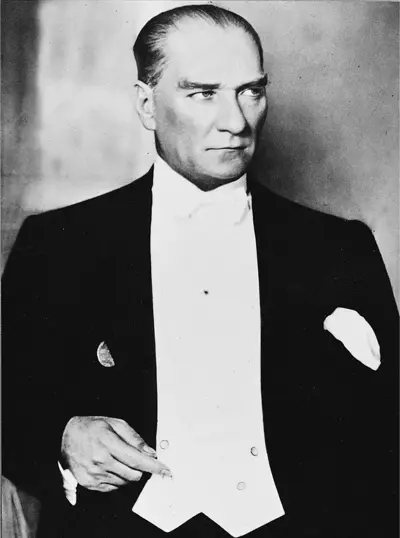
- Born: May 19, 1881
- Died: November 10, 1938
- Nationality: Turkish
- Profession: Leader
Kemal Atatürk was a Turkish field marshal, revolutionary statesman, author, and the founding father of the Republic of Turkey, serving as its first president from 1923 until his death in 1938. He undertook sweeping progressive reforms, which modernized Turkey into a secular, industrial nation. Ideologically a secularist and nationalist, his policies and theories became known as Kemalism. Due to his military and political accomplishments, Atatürk is regarded as one of the most important political leaders of the 20th century.
