King James I Quotes
The king is from God, the law from the king.
James I, 1566-1625, King of Great Britain & Scotland (James VI of Scotland), Attributed
Sourced by: Eigen's Political and Historical Quotations


England had, under Henry VIII, left the Roman Catholic Church where the King replaced the Pope as head of the English Church. Henry’s successors then had to organize and manage the national Christian church. James was discussing the hierarchy of the Church of England and there was a suggestion that Bishops be eliminated and have every priest directly responsible to the crown. Bishops would be powerful figures who might form a power center. (They did later). However, King James I observed that the King is God’s choice and rules by divine right. So there had to be bishops to crown kings. The bishoprics were retained.


She was Queen of Scotland and claimed the English throne as well. While Elizabeth I was on the throne of England, Mary claimed that the court had no jurisdiction over an absolute monarch. Her son was in France at the time but eventually succeeded to the Scottish throne as James VI and the English throne as James I.

William the Conqueror. See Henry of Huntington for another similar description of the King's authority.

Joseph ben Matthias. There a different kinds of theocracy, There can be a Pope, a King, or a Supreme Leader who acts as the chief magistrate using a religious tract as the law of the land. The Ancient Jews had a Republican Theocracy were the leaders were chosen by the people but they did not promulgate any laws. The Torah—the first 5 books of the Old Testament—was the law of the land. In comparison. 21st century Iran recognized the Koran as the source of Laws. However, their chief magistrate was a cleric—the supreme leader who is not elected but appointed by a few other clerics. None of the other Iranian leaders are chosen by the people because all candidates must be approved by the Supreme Leader in order to even stand for election. So the ancient Jews had a republican theocracy, while Iran was an autocratic theocracy.

This quotation illustrates the negative attitudes towards democracy that existed with many “leaders” of the time. Stuyvesant was appointed by and reported to the Dutch West India Company—not to the government of Holland. New Amsterdam was a commercial venture just as most of the English American Colonies were. Stuyvesant was not a particularly good governor in terms of both making money for the company or governing the new city.

He was stating for France what the English King James I had said a few decades earlier. See {616307}.


Typical of the times, the king was accountable to no one for anything. 200 years later, most of the world have accepted the principle that no one is above the law and that every leader is accountable to the people.

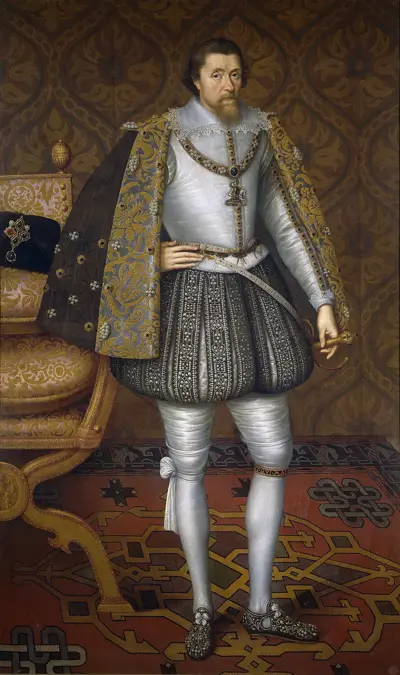
James VI and I was King of Scotland as James VI from 24 July 1567 and King of England and Ireland as James I from the union of the Scottish and English crowns on 24 March 1603 until his death in 1625. The kingdoms of Scotland and England were individual sovereign states, with their own parliaments, judiciaries, and laws, though both were ruled by James in personal union.
