Samuel Langdon Quotes
… let them who cry up the divine right of Kings consider, that the only form of government which had a proper claim to a divine establishment was so far from including the idea of a King, that it was a high crime for Israel to ask to be in this respect like other nations.
Samuel Langdon, 1723-1797, President, Harvard University Sermon, Government Corrupted By Vice, 1775
Sourced by: Eigen's Political and Historical Quotations


He was stating for France what the English King James I had said a few decades earlier. See {616307}.

Joseph ben Matthias. There a different kinds of theocracy, There can be a Pope, a King, or a Supreme Leader who acts as the chief magistrate using a religious tract as the law of the land. The Ancient Jews had a Republican Theocracy were the leaders were chosen by the people but they did not promulgate any laws. The Torah—the first 5 books of the Old Testament—was the law of the land. In comparison. 21st century Iran recognized the Koran as the source of Laws. However, their chief magistrate was a cleric—the supreme leader who is not elected but appointed by a few other clerics. None of the other Iranian leaders are chosen by the people because all candidates must be approved by the Supreme Leader in order to even stand for election. So the ancient Jews had a republican theocracy, while Iran was an autocratic theocracy.


the Jews of Ancient Israel
Bartolomeo Fiadóni -- Tolomeo da Lucca -- Bartholomew of Lucca

This is one of the passages of the Bible that Christian Kings cited in expecting obedience. Most of the monarchs took this passage to mean that God had selected and appointed them to rule.

Typical of the times, the king was accountable to no one for anything. 200 years later, most of the world have accepted the principle that no one is above the law and that every leader is accountable to the people.

Alfonso the Learned. He personally wrote a History of Spain up to the time.

The early human idea that human rulers must somehow divine and/or designated and supported by the deity was present over many cultures and geographies.


In 1848 a number of revolutions flared throughout Europe with a call for democracy rather than monarchy. The Prussian king was one of those who really believed that he was selected by God to rule, was very frightened and tried to enlist the Queen and England to present a united front against the revolutionaries. England, which had already had a strong functioning parliament and extensive voting suffrage, protected most of the rights of its citizens and was a Constitutional Monarchy where there were limits to the power of the monarch. Further, Victoria was extremely popular and in many ways was far ahead of the electorate in terms of modern democratic reforms. So she was not in the panic of many of the other crowned heads of Europe were in. Somewhat following the example of England, King William IV allowed a parliament and minimized the strong military role that characterized Prussia. Most of the 1848 revolutions failed to sieze governments but, as with Prussia, forced reforms in what was a long movement to European democracy that would take another 150 years. Note also the logic about religion. Since the revolutionists did not believe in the divine right of kings, they opposed God’s will on earth. Therefore, they opposed God and must be atheists. Almost all counter revolutionary accusations included the claim—often not true—that the revolutionaries were atheists.

Cromwell was not opposed to monarchy per se as long as it was reasonably checked. He saw Charles II as a terrible monarch. After deposing Charles, he and his associates had to come up with some form of government. As “Lord Protector” he was a de facto monarch without the trappings.

During the American Revolution many patriot clerics argued against the monarchy by claiming that God has given Kings to the Ancient Jews—who had a type of Republic—as a punishment. Therefore monarchy is to be avoided.

This is one of the best, short, historical summaries of the Ancient Jews’ governmental structure after the Exodus from Egypt. They had, to the best of our knowledge, the first republic, although the orthodox Jews do not credit the Jewish people. It was the Almighty who created the Republic and ordered them to live under it. Later, the Jews wanted Kings, and they had them, destroying the Jewish Republic and creating a Jewish Empire where the kings ranged from good to horrible. Ultra-orthodox Jews in modern Israel, reject the Democracy, and believe. Like ultra-orthodox Muslims, that God rules and not kings or the people or representatives chosen by the people.
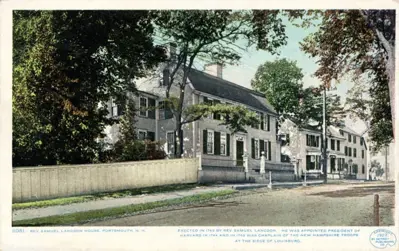
Samuel Langdon was an American Congregational clergyman and educator. After serving as pastor in Portsmouth, New Hampshire, he was appointed president of Harvard University in 1774. He held that post until 1780.
