Calvin Coolidge Quotes
July 4, 1776 was the historic day on which the representatives of three millions of people vocalized Concord, and Lexington, and Bunker Hill, which gave notice to the world that they proposed to establish an independent nation on the theory that all men are created equal, that they are endowed by their creator with certain inalienable rights, that among these are life, liberty, and the pursuit of happiness.
Coolidge, Calvin. "Speech on the 150th Anniversary of the Declaration of Independence." Philadelphia, PA, 5 Jul. 1926.


This resolution of independence was voted upon a month before the Declaration of Independence. It was approved by 12 of the colonies but not by New York. The Congress appointed a committee to draft what became the Declaration of Independence and that was approved by all the colonies. The resolution was introduced by Richard Henry Lee on instructions from Virginia. The graphic is of Lee’s original notes.


Jefferson’s original was: We hold these truths to be sacred and undeniable that all …
Jefferson, who drafted the declaration, asked Franklin to edit it—see {604295}. This phrase was suggested as a replacement for Jefferson’s original: “We hold these truths to be sacred and undeniable.”


This was written more than a year before the American Revolution Battles began. It took time to ship the men and supplies to America and the British did not handle that task with much efficiency. See {636926} for another of the King’s statements.

As a result was in 1799 he was indicted, convicted, and fined $480 and sentenced to 18 months in jail. In 1801, newly elected President Thomas Jefferson pardoned Brown along with all violators of the act.

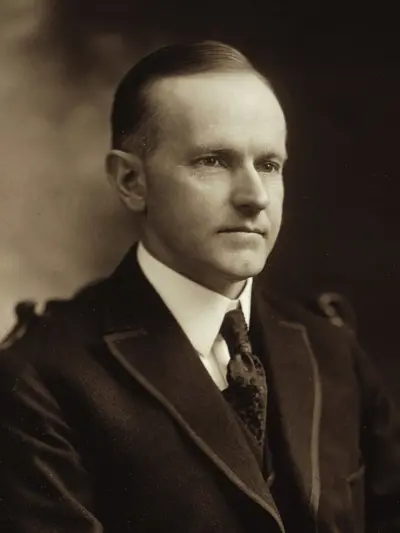
Calvin Coolidge was an American lawyer and politician who served as the 30th president of the United States from 1923 to 1929. A Republican lawyer from New England, born in Vermont, Coolidge worked his way up the ladder of Massachusetts state politics, eventually becoming governor of Massachusetts. His response to the Boston Police Strike of 1919 thrust him into the national spotlight and gave him a reputation as a man of decisive action. The next year, he was elected the 29th vice president of the United States, and he succeeded to the presidency upon the sudden death of Warren G. Harding in 1923. Elected in his own right in 1924, he gained a reputation as a small-government conservative and also as a man who said very little and had a rather dry sense of humor.
