John F. Kennedy Quotes
It is much easier in many ways for me ... when Congress is not in town.
John F. Kennedy, 1917-1963, 35th President of the United States (Democrat, MA), Press conference, Washington DC, June 28, 1962
Sourced by: Eigen's Political and Historical Quotations


In the early years of the Obama Administration, the minority leader of the Senate declared that the object of the Republicans in the Senate was to prevent Obama from being reelected. Therefore, the Republicans used the filibuster to block virtually all legislation. In 2010, the Republicans gained control of the House of Representatives and would not pass any legislation that the President favored lest he get credit for accomplishing something. It had gotten so bad, that even when the President proposed Republican ideas about which everyone agreed, that too was blocked.


This was one of the worst Congresses in American History and had the worst productivity record—passing very few bills, and none of any significance. The anti-government, Tea Party hyper-conservative Wing of the Republican Party intimidated the Speaker of the House and they were opposed to any compromise at all on anything.


His Republican Party had filibustered more bills in the Senate then had been done previously in all of the Senate History together. Congress passed fewer bills in his first two years than any other Congress in history.


The Republicans who had control of the House of Representatives were reaching the end of the fiscal year and had not yet passed a budget nor expanded the debt ceiling so the government would have to shut down in a few days and a little later America could not pay any of its bills. They had a very strong position if they willing to blackmail the Democratically controlled Senate and the Democratic President. But the last time the Republicans had ever tried this before was the Republican House when Gingrich was speaker and they shut down the government for almost 3 weeks. It cost the Republicans the next election’s majority in the House. President Obama decided that he would not set a precedent of negotiating with a house of Congress that was threatening to shut down the government or threatening not to pay the nation’s bills which Congress had already authorized the purchase of.

Boehner’s Republicans controlled the House of Representatives. However the Democrats controlled the Senate and Obama, the president, was a Democrat. So while Boehner could block any legislation, he could not pass legislation that the Republicans wanted. So the speaker resorted to the tactic of holding for ransom import legislation unless the President and the Democrats would pass legislation that the majority of the public and the Democrats were against. In this case it was the debt ceiling limit. The United States spends money authorized by Congress and then has to pay the bills. When the country is growing, the government has to borrow money in order to meet its obligations and pay bills. Congress must authorize the increase in the debt limit. Boehner held the debt limit hostage until Obama would agree to spending cuts that were unpopular with the majority. A problem for the Republicans with this strategy however was that the government would not have enough money to pay the regular bills and the government would have to slow down. This was considered a most unpatriotic thing to do and one would put the United States full faith and credit at risk. Republicans justified it on the grounds that spending money as the government was doing was worse and therefore it requires extreme measures. This was not the only occasion where a political party put its ideology ahead of the welfare if the nation as a whole. But in those few past occasions the party doing this was not overt about it, and could never be accused of blackmailing. What made this quotation remarkable was that it was the first time that the politician was very explicit about the blackmail strategy. President Obama actually caved in a bit and compromised and reduced spending so the debt ceiling was raised. Earlier, President Clinton had the same tactic tried on him but he let the Government shut down, and after a few days, The political heat on the Republicans were so great that they had to raise the debt ceiling and reopen the government.


In the beginning of the 21st century political hyper-polarization made Congressional gridlock the norm. Anything that was acceptable to the Democrats would be rejected by the Republicans and vica versa. However, at times, the public would be impassioned by events and demand Congressional action. A movement for gun control after a serious of massacres with assault weapons in 2012 was the example that Thomas was using. If the legislative process could be stretched out until public passions waned, the normal gridlo{78528}k would control and there would be no reform.


The historian was comparing Obama to other historical presidents who either had a majority of both Houses of Congress or had an opposition party that was generally quite cooperative and willing to compromise for the sake of running the country smoothly. At this point in time there was a Tea Party wing of the Republican that was particularly negative and obstructionist. They tended to threaten and intimidate the main stream Republicans who used the filibuster to block legislation the majority of Senators had voted for more times than all the other Congresses in American history. And that was only in Obamas first 6 years.


At the beginning of the Trump presidency, he had a very diffferent idea of the role of the Senators in the Appontment of the Cabinet then other Presidents have had and certainly that most senators had. However, the Republicans held the majority and most were cowed by the threat of Trump encouraging the nativists and the Tea Party to run against them from the right in the next primary.


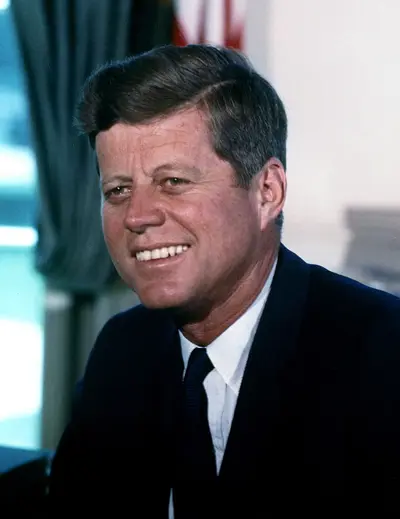
John Fitzgerald Kennedy, often referred to by his initials JFK, was an American politician who served as the 35th president of the United States from 1961 until his assassination in 1963. Kennedy served at the height of the Cold War, and the majority of his work as president concerned relations with the Soviet Union and Cuba. A Democrat, Kennedy represented Massachusetts in both houses of the U.S. Congress prior to becoming president.
