Abdul Rahman Al-Sudais Quotes
Islam is a religion of peace that abhors attack on innocents ...faith does not mean killing Muslims or non-Muslims who live among us, it does not mean shedding blood, terrorizing or sending body parts flying.
Abdul Rahman Al-Sudais, Saudi Arabian Islamic Cleric & Imam of the Great Mosque of Mecca, Sermon on the Festival of Eed, January 21, 2005
Sourced by: Eigen's Political and Historical Quotations

Muslim clerics throughout the world had been relatively mild in their criticism of Islamic Extremists and Terrorists. Delic was one of those who urged stronger moral statements. Many of the Muslim clerics in the world actually were themselves holders of Wahhabi and other extremist views. However, many also opposed terrorism and felt that there was nothing in Islam that could justify the indiscriminate killing. However, a number of these were intimidated lest an extremist Muslim cleric issue a Fatwa calling for his death for heresy. Most of us did not then, and even today, do no really understand the extent and frequency of these threats in the Muslim world (and even in the West) and the very frequent assassination or serious wounding of those Muslims who publicly criticize the extremist terrorists. Delic had much more courage than most.


One of the strong motivations of Islamic terrorists is the fact that they believe that a Muslim who dies fighting for Islam goes immediately to Paradise. However, terrorists create Hell for innocent civilians and people who have no desire to harm Islam—in many cases babies and young children who do not even know what religion is. While this statement represents the beliefs of most moderate Muslims, it was made after he was out of office. It is doubtful that an Iranian President—a position without much power in the Iranian theocracy where the religious leader rules—in office would dare say something like this when Iran supports Islamic terrorist organizations throughout the world.

Nigeria was about equally divided into Muslims who dominated the North and Christians and Animists who dominated the South. The former were intent on making Sharia—Islamic Law—the law of the nation and the latter were equally passionate to avoid it. Muslim protests got very violent including murdering innocent civilians; the Christians threatened to retaliate.

This is a particularly noteworthy quotation as Muslims are often accused of intolerance and here is a Muslim who argues that it is the responsibility of religious leaders to present religion in a tolerant manner.

Islamic religious extremists do not allow freedom of religion, freedom of speech, freedom of the press, right to life, freedom from torture and mutilation, self-government, gender equality, protection of children or women from violence, sexual freedom, freedom of expression, reproductive rights for women, right work, which are just a few. The modern Islamic extremists allow about the same human rights as did the Christian Kings and the Church of 1000 years ago. Ironically, it is less respect for human rights that many of the great Islamic societies provided 1000 years ago.


“Martyrdom” is the euphemism that fundamentalist Muslims use to denote being killed while “fighting for Islam” or on a suicide mission for same. Many believe that such people ascend directly to Paradise where they are given a bevy of virgins and other “perks.” Ironically, this was the last interview that he gave before he himself was “martyred”—he was killed by coalition troops. This mental perspective is one of the reasons that fighting fundamentalist Islamic terrorists is so difficult. They perceive victory whichever way the battle or even the war comes out.

With the partition of India forming an independent Pakistan, ethnic riots broke out and millions of people were killed. This joint statement was issued to try and quell the violence but it had progressed too far. Jinnah as a political ploy to obtain the partition organized Muslims and threatened violence—see {627153} and {627169}. Things got out of hand with ethnic cleansing being an objective in many localities—see {627146} and {627149}.

She is a leading American Arab who is a Syrian expatriate.


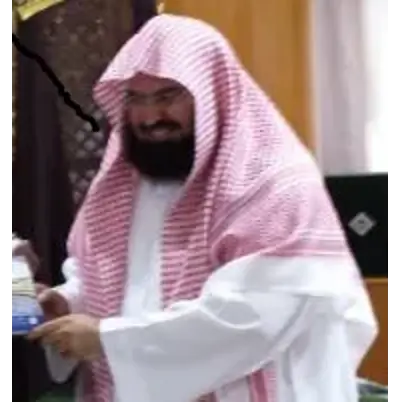
Abdul Rahman Ibn Abdul Aziz al-Sudais (Arabic: عَبْدُ ٱلرَّحْمَٰنِ بْنُ عَبْدِ ٱلْعَزِيزِ ٱلسُّدَيْسِ, romanized: ʻAbd ar-Rahman ibn ʻAbd al-Aziz as-Sudais;) better known as Abdulrahman Al-Sudais is the imam of the Grand Mosque Masjid al-Haram in Makkah, Saudi Arabia; the president of the General Presidency for the Affairs of the Two Holy Mosques; a renowned Qāriʾ (reciter of the Qur'an); and was the Dubai International Holy Qur'an Award's "Islamic Personality Of the Year" in 2005. Al-Sudais has preached Islam's opposition to "explosions and terrorism", and has called for peaceful inter-faith dialogue, but also been sharply criticized for vilifying non-Muslims and especially Jews in his sermons. He has denounced the treatment of Palestinians by Israelite settlers and the state of Israel, and called for more aid to be sent to Palestinians. He has also been noted for identifying women's un-Islamic behavior as in part responsible for the winter 2006 drought in Saudi Arabia. In 2016, he delivered the very important Hajj sermon to a multitude of pilgrims gathered at Arafat after prayers.
