William E. Gladstone Quotes
Ireland forces upon us these great social and great religious questions—God grant that we may have courage to look them in the face.
There are no issues, moral, military, political, economic, or social that have vexed British society for as long as the issues raised by Ireland and its complex relationship with Great Britain.
William E. Gladstone, 1809-1898, British Prime Minister (Liberal), Letter to his wife, Quoted in Jonathan Bardon, A History of Ireland
Sourced by: Eigen's Political and Historical Quotations

English history has been replete with Catholic-Protestant conflict and because of the British Empire, the British historians were very familiar with the Islamic conflict with Christianity, Judaism, Hinduism, and other religions. Toynbee was very worried about the future religious struggles and he turned out to be right. Freedom isi amenable to different interpretations and compromise. Religion also has different interpretations, but many of the religious fundamentalists see compromise as an offence to God and his word. So religion is less amenable to political, civil or social structuring and compromise.


1st Earl Baldwin of Bewdley

Plunckett was the last Roman Catholic martyr to be executed in Britain. He was accused of conspiring against the state by allegedly plotting to bring 20,000 French soldiers into the country, and for levying a tax on his clergy to support 70,000 men for rebellion. The English have always feared ever since Henry VIII severed England from the Roman Catholic Church, that the Papacy was plotting to restore Catholicism to England and sponsor an invasion of Ireland. And indeed that was true in several cases, but nowhere near as many as the English imagined. In this case, paranoia prevailed, and the trial was pretty much a farce, but he was convicted and sentenced to be hanged, drawn and quartered which he was.


Arguments against the Partition of India at the time centered around the poor economic viability of a separate Muslim state. However Iqbal and others placed the cultural issues in the forefront. They eventually prevailed.

A police officer in Chicago had refused an assignment to guard an abortion clinic that had been threatened. He was offered a transfer to a district that had no abortion clinics, but refused to be transferred. He was fired then and the courts upheld the city’s right to fire him.


Ingersoll was considered to be the greatest orator and political thinker of his day, but his overt atheistic views curtailed his elected political career.

Anne was a Protestant but her father James II was a Roman Catholic. There was always suspicion about her true religious allegiance by the extremists in the Church of England. The Act of Toleration, despite its name, required the Church of England to be the established church and the sovereign’s to be the heads of the church.

For the majority of the time of Christian History, it has been Catholic Christian History. Protestantism did not begin until the 16th Century.


The Irish monks were loyal to the pope and were outraged when he was displaced by King Henry VIII. They were seen as a hotbed of disloyalty and therefore ordered to close. This is one of the many examples where an established government church dictated not only how people should worship but also prohibit other religions from functioning. These examples were well known to the American Founding Fathers and much of educated American opinion which was one of the drivers of the First Amendment and the separation of church and state.


Wesley had been to Island several times and was interested in affairs there. He was a strong advocate of freedom of religion but the violence of the earlier religious conflict made him very wary of the Irish Roman Catholics who seemed to him particularly prone to religious violence.

New Ross was under siege by Cromwell and his English Parliamentarian troops. After two days, the town tried to negotiate terms of surrender and one of the main things they asked for was freedom of religion to practice Roman Catholicism. This famous response set the stage for religious bigotry over the next years. Cromwell’s reasons for not allowing Catholicism to be practiced was not only one of religious zeal. At the time, the Roman Catholic Church was a major geopolitical power under a Pope who commonly supported or even dispatched troops for geopolitical and religious ends. The Vatican was particularly resentful of England for separating from the Church and asserting that the King of England was the head of the Church and not the Pope. Therefore Cromwell and many Englishmen had to deal with the reality that every practicing Catholic in the realm was a potential spy, traitor, and/or rebel. This fear of control of countries by the Pope strongly affected America, and was responsible for the defeat of the first Catholic Presidential Candidate, Al Smith. It was also a major factor in the election of John F. Kennedy so he dealt with it head on.

He lost be 2 votes.

Starting with the Crusades, the Popes began giving indulgences to those who would die in battle fighting for a holy cause. The Papacy was then at one of it’s lowest points. Two men, Clement and Urban, both claimed the Papacy and each had raised an army to fight the other. Each was promising indulgences to those who would fight, and in a modality similar to the Muslim terrorists of the 21st century, the soldiers were promised ascendancy to Heaven if the fell in battle for such a holy cause. Wycliffe, in a wonderfully original notion, proposed that the people who live in peace be granted the indulgences. See {618086}.

He was particularly referring to the reigns of Queen Elizabeth I and James I.

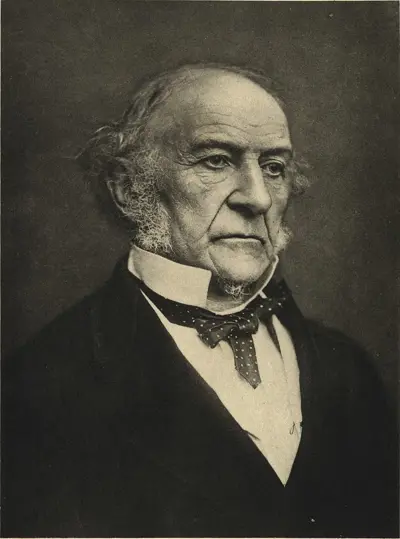
William Ewart Gladstone FRS FSS was a British statesman and Liberal politician. In a career lasting over 60 years, he served for 12 years as Prime Minister of the United Kingdom, spread over four terms beginning in 1868 and ending in 1894. He also served as Chancellor of the Exchequer four times, serving over 12 years.
