Janis Karpinski Quotes
In November, they transferred control of Abu Ghraib to the military intelligence command completely; it was, after all, the center for interrogations for Iraq.
Karpinski, Janis. "One Woman's Army: The Commanding General of Abu Ghraib Tells Her Story." Carnegie Council for Ethics in International Affairs, 22 Nov. 2005.


Abu Ghraib was the prison in Iraq where prisoners were brutalized and treated illegally and immorally. Seymour Hirsh was the Pulitzer Prize-winning investigative journalist who broke the story. Levy contrasted that where the Algerian War was full of such atrocities but French intellectuals and press would not publicize it. It didn’t stop for the whole war.


There has always been some confusion in the case of the Wars in Afghanistan and Iraq. The Geneva and Hague conventions are very clear when prisoners are official members of an state’s armed force with uniforms, insignia and ranks. It is also clear with respect to civilians. But the combatants of the insurgent and terrorist forces fall in between, and international law is less clear. The George W. Bush administration at first took the position that the captured combatants were not captured soldiers and were therefore not entitled to the treatment due that status. But the military regulations made no distinction as to how prisoners in combat should be treated. It is a very gray area, except that in either case, torture is illegal under U. S. and under International law.

Abu Ghraib was the major prison in Iraq during the Iraq War. American military committed many crimes on prisoners ranging from murder to sexual humiliation. The actual perpetrators claimed that the higher ranks of officers knew what was ongoing and provided the policies, rules and culture of the prison. The president and the Vice President many thought were the officers responsible and violated the Uniform Code of Military Justice. Their administration had issued a legal memorandum that for the first time in American history would allow some kinds of torture of prisoners in the War on Terror. A few enlisted personnel were punished and a general was transferred but no senior military or civilian personnel were held responsible or punished.


Khanenei failed to make three important distinctions. First, the crimes committed by American forces in Abu Ghraib and Guantanamo were NOT the policy of the American government whereas all of Hitler’s crimes were not only government policy but Hitler had laws passed to enable these atrocities. Bush and the American Military command may have not been competent enough to prevent the problems, and may have been too lenient to punish the guilty, but they never intended them to occur. Second is scale. Abu Ghraib and Guantanamo illegalities led at most to the deaths of one or two people. Hitler killed over 6 million in his prisons. Third, as soon as Bush found out about the problems, they were stopped whereas Hitler continued until militarily removed from power and neutralized.

In the War on Terror, some CIA officers had gotten a George W, Bush Administration green light to torture some captured terrorists using a torture technique known as “water boarding”—a practice for which American military personnel were court marshaled and convicted in the Philippine War. The torture sessions had been videotaped, a normal procedure with CIA interrogations. The fact of the torture had leaked and a national scandal ensued with Americans on both sides of the question. President Bush and his Vice President publicly stated that the United States does not torture. Rodriguez then ordered the tapes destroyed. Later he gave his reasons after the Obama Administration decided not to investigate the matter or determine which, if any, CIA officials might have broken the law, by wither doing the torturing or destroying evidence—“obstructing justice.”


Abu Gharib was a prison in Iraq in which the officers in charge and the command structure failed to prevent a number of American soldiers from abusing and sexually and religiously humiliating Muslim prisoners. Photographs of the abuses traveled around the world and that particular unusual incident unfortunately fit the propaganda preconception of the Americans promoted by Islamic fundamentalist extremists. Tragically, as General McChrystal observed, Abu Gharib served as a recruiting tool for the terrorists.


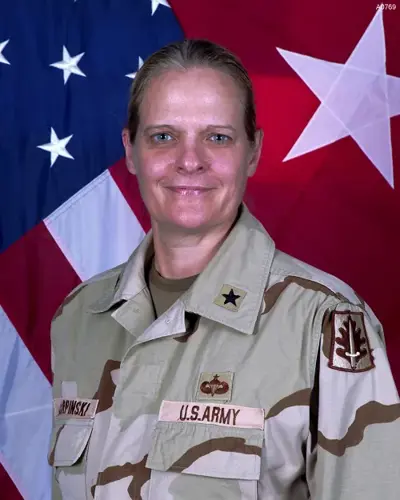
Janis Leigh Karpinski is a retired career officer in the United States Army Reserve. She is notable for having commanded the forces that operated Abu Ghraib and other prisons in Iraq in 2003 and 2004, at the time of the scandal related to torture and prisoner abuse. She commanded three prisons in Iraq and the forces that ran them. Her education includes a Bachelor of Arts degree in English and secondary education from Kean College, a Master of Arts degree in aviation management from Embry-Riddle Aeronautical University, and a Master of Arts in strategic studies from the United States Army War College.
