Janis Karpinski Quotes
The day after the prison was transferred to the military intelligence command, they had an entire battalion - 1,200, 1,500 soldiers - arrive at Abu Ghraib just for force protection alone.
Karpinski, Janis. "One Woman's Army: The Commanding General of Abu Ghraib Tells Her Story." Carnegie Council for Ethics in International Affairs, 22 Nov. 2005.


There was extensive hostility expressed by civilian populations in Pakistan and other countries where the United States made Drone strikes to take out terrorist leaders. However, there was much anti-American feeling in Pakistan before the Drone strikes.
Although the Amerian Drone program did inadvertently kill untargeted or mistakenly targeted civilians at that time, the collateral damage rate was smaller than any other weapons system available to the American forces. War has always produced unintended collateral damage. The only way to stop the killing of innocent civilians then and now is to stop the war.

He was not advocating this level of military presence. He was explaining that there is a trade-off between safety and civil rights and quality of life.

The President and Vice President wanted places to interrogate suspected terrorists where they did not have to obey American law, where the press could be kept away from the prisoners, and there would be no way that a prisoner could get the assistance of attorneys and American Judges could not have any jurisdiction. A number of the prisoners had been picked up by mistake, or were accused by people who had scores to settle, and if the CIA had made a mistake, the public could not find out. Further, they wanted to torture certain prisoners and wanted places where they could use their “enhanced interrogation”—see {637536}--without the public finding out.

The United States should be One major problem at the time was that the Soviet Union was supporting and instigating revolutions in many parts of the world. When most nations of the UN wanted to provide peace keeping troops to quell the conflict, the Russians would veto and block the effort, Vandenberg wanted the UN to change the rules regarding the veto. The original right of veto for the major nations was originally included at the insistence of the United States and many Americans did not want to give it up or have any exceptions lest there be more. The Russians at that time also did not want to give up any of their veto powers. Another method that Vandenberg wanted to solve the Russian peacekeeping blockage problem was for America to engage in more collective security pacts so that action could be taken without UN Security Council unanimity by going around the UN.


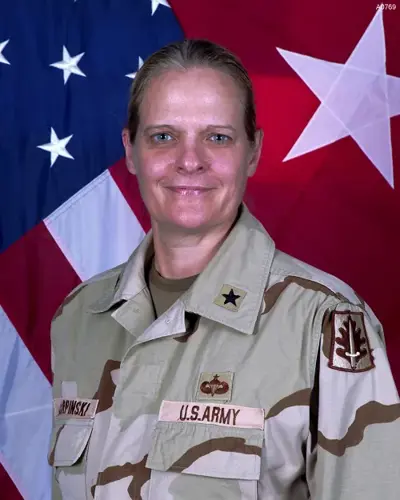
Janis Leigh Karpinski is a retired career officer in the United States Army Reserve. She is notable for having commanded the forces that operated Abu Ghraib and other prisons in Iraq in 2003 and 2004, at the time of the scandal related to torture and prisoner abuse. She commanded three prisons in Iraq and the forces that ran them. Her education includes a Bachelor of Arts degree in English and secondary education from Kean College, a Master of Arts degree in aviation management from Embry-Riddle Aeronautical University, and a Master of Arts in strategic studies from the United States Army War College.
