Joseph P. Bradley Quotes
In my view, a law which prohibits a large class of citizens from adopting a lawful employment, or from following a lawful employment previously adopted, does deprive them of liberty as well as property, without due process of law. Their right of choice is a portion of their liberty; their occupation is their property. Such a law also deprives those citizens of the equal protection of the laws…
Joseph P. Bradley, 1813-1892, U. S. Supreme Court Justice, Dissent, Slaughter-House Cases 1873
Sourced by: Eigen's Political and Historical Quotations

The call for individual liberty and the right of personal property by clergy is surprising to many. This Cahier was the consensus of the Clergy of Blois in 1789. There were cahiers of several provinces of France—some by the clergy, some by the nobles. What is fascinating is the emergence of many of the pre-Revolutionary French concepts. The example of the American revolution and its principles was known throughout the educated classes of France.


He had been a Congressman before assuming the Presidency. Civil rights was a major subject of debate after the Civil War. One major issue was that of citizenship itself. Many contended that Americans were citizens of a state and dependant on the state for the protection of civil rights. However, the extent to which the Federal government could and should be the guarantor of citizenship issues was in dispute. Today with the issue settled in favor of Federal preeminence, it is hard to realize that this was very unsettled at one point in history. Garfield was one of those leading the effort for more Federal involvement and control.


At that time, ideology was not a driving political force and individual politicians often were hard to classify. For example, Humphrey was at the far left—an ultra liberal. Yet he was a staunch advocate of the right to bear arms. 50 years later there were no liberals who did not want to restrict gun ownership, And at that time, many Republicans were advocates of gun control, an unheard of situation in the 21st century beginning.


To the pro-slavery politician, abolition was an abdication of government to fulfill it’s 3 major responsibilities. Slaves were private property and government had to safeguard the owner’s right to own that property. Slave owners had always been free in America to hold slaves, and abolition impinged on that freedom. And the slavery advocates knew better than the abolitionists how cruelly the slaves had been treated. They reasoned—that if anyone had treated them that way, they would if they could take revenge and kill the slave owners. Therefore, abolition threatened the lives of Southern citizens. Of course, Brown and his fellow slave-owners did not consider the fact that they had interfered with the right of the slave to own property, they denied him freedom, and in many cases killed slaves as examples or out of neglect. Their “logic” was that slaves were not citizens and therefor were not entitled to these protection.


The first Civil Rights Act {587712} was passed a few months before and has some of the same language as Congress wanted to make the laws very clear. The Southern Rebels who insisted on their right to have guns during Reconstruction, viciously denied that same right to the newly freed slaves. Sickles tried to remedy this, but the KKK and other terrorists intimidated most of the Blacks into not using the right that they had. Later, they would do that with the right to vote. In January, the Commanding General in charge of South Carolina had issued an order protecting the rights of Blacks to have guns {629894}. This law applied that to the entire country. The Southerners have always supported the 2nd Amendment except when Blacks wanted to have arms.


Wilson was using logic and consistency to show the absurdity of the proposal to count three fifths of the slaves as people for the apportionment of congressional seats. Particularly difficult for the Southern States to refute was his point that who should other property not be considered in addition to slaves in the apportionment formula? Factories, farms, land value, raw materials, merchandise, etc. That compromise however prevailed regardless of its inconsistency and failure to adhere to any principles. This was the only way to have the South join the new nation.


Originally it was published in Boston under the name “A Columbian Patriot.” She was worried about the jurisdiction of the Supreme Court extending throughout the country and yet the nation was very much smaller then than it is today. However, transport and communications have grown with the country.
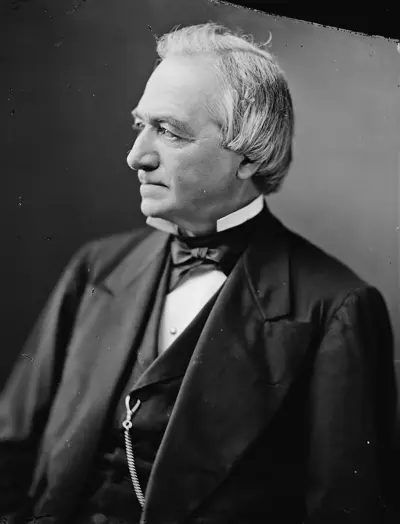
Joseph Philo Bradley was an American jurist best known for his service on the United States Supreme Court, and on the Electoral Commission that decided the disputed 1876 presidential election.
