Ulysses S. Grant Quotes
If we are to have another contest in the near future of our national existence, I predict that the dividing line will not be Mason and Dixon’s but between patriotism and intelligence on the one side, and superstition, ambition and ignorance on the other.
Most historians agree that by “superstition,” Grant was referring to the Catholic Church, which had been steadily growing will more and more immigrants arriving in America. There was great hostility between Protestants and Catholics at the time.
Ulysses S. Grant, 1822-1885, 18th President of the United States (Republican, OH), Speech in Des Moines, Iowa, October 29, 1875
Sourced by: Eigen's Political and Historical Quotations


The classic dilemma is that religious moderates and scientists do not argue to force everyone to follow the dictates of science, but in almost all societies and nations, religious fundamentalists strive to force their beliefs on all and make disagreement illegal.

He meant gender, not the frequency of sexual activity.

From the latter part of the 20th century onward, religious nationalism was no longer a force for most religions and nations except Muslim countries. It was the only religion left where a large proportion of the adherents saw no distinction between the religion and the government. Nations that had separation of church and state were not conducive to the extreme fundamentalist form of Islam where the Secular Leader and the Religious leader was to be embodied as a single person. As a result Islamic religious nationalists argued for a Theocracy and at times fought for it with violent means. The secular government typically, to curtail the violence and prevent a religious takeover, often outlawed the extreme religious Islamic parties. While Aslan cites the Muslim Brotherhood failure in Egypt as a desirable outcome, the only way the other forces of Egyptian society could prevent the Islamists from taking over turning the country into a theocracy was to forcefully repress the extremists. The Turkish outcome was much better, but there was the threat of repression of the Justice and Development Party when it won a majority control of the government. There were explicit threats that if it tried to weaken the secular nature of the government as Ataturk had formulated it, the military would come “out of the barracks” and oust the government as they had done before. There were nations like China which persecuted religions such as certain forms of Christianity, but those religions were not fighting for religious nationalism. They only wished the freedom to practice their religion and had no program or theology that argued for Christianizing the government. The Tamil Hindus of Sri Lanka did not want a Hindu government and were perfectly free to practice their religion. The problem was that they felt that there was systemic social and economic discrimination against the Tamils and they fought for independence—not of a Hindu state, but of a secular, nondiscriminatory state of equal opportunity.

While this was his opinion, it was never issued in a Papal Bull or had the force of Catholic law. Meanwhile, almost all of the socialist movements in the West have had Catholics in their leadership and many democrats of modern times would have been considered socialist. Many countries with high proportions of Catholic voters have elected socialist governments in secluding Spain and Italy.


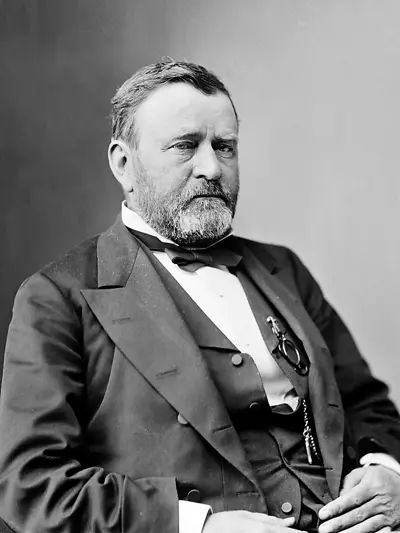
Ulysses S. Grant was an American military leader who served as the 18th president of the United States from 1869 to 1877. As president, Grant was an effective civil rights executive who created the Justice Department and worked with the Radical Republicans during Reconstruction to protect African Americans. As Commanding General, he led the Union Army to victory in the American Civil War in 1865 and thereafter briefly served as Secretary of War.
