George III Quotes
I would rather risk my Crown than do what I think personally disgraceful ... it is impossible that the nation shall not stand by me; if they will not, they shall have another King.
George III, 1738-1820, King of England & Ireland, King of Hanover, Letter to Lord North, March 17, 1778
Sourced by: Eigen's Political and Historical Quotations


Ataturk was a young major at the time commanding troops of a weak and corrupt Ottoman regime. However a combined English and French (the strongest military powers in Europe) invasion of the Gallipoli Peninsula threatened to capture the Turkish capital, Constantinople. Ataturk alone rallied the Turkish defenders and fought the invaders to a standoff in long drawn out battle with huge casualties on both sides. Ataturk became a national hero. Although Ataturk thereafter was very reluctant to use military force or endanger troops, the thing he always thought worth the supreme sacrifice (including his own) was the independence and sovereignty of the nation. See {584502} for his continuing belief in this type of sacrifice.

Historically almost all dictators seized their power and war criminals committed their murders to “save their nation.”


Lord Murray had decided to support Prince Charles in his attempt to seize the Scottish Crown. His statement is one of the great examples of self-interest yielding to principles. Note that the capitalization of “King” and “Country” are the Lord’s and reflects the majesty that these words then reflected.


The Emperor had made his brother King of Holland to function as a French military Governor. But Louis Napoleon. Who took an oath as the King of Holland, took his oath and responsibilities seriously and tried to serve Dutch interests which his brother cared for not at all. Louis Napoleon had an impossible situation with dual loyalty that was incompatible.
Colonel Banks had given him the Regimental colors flag and urged him to take care to return it with honor. This was his famous reply. In the midst of the Battle he was hit fatally with a cannonball. A Black corporal then took up the colors and he too was killed and yet another Negro corporal took the flag and returned it after a battle where the Blacks were commended for their valor. This quotation has been quoted to military men and women throughout the world as an outstanding example of military bravery and honor..


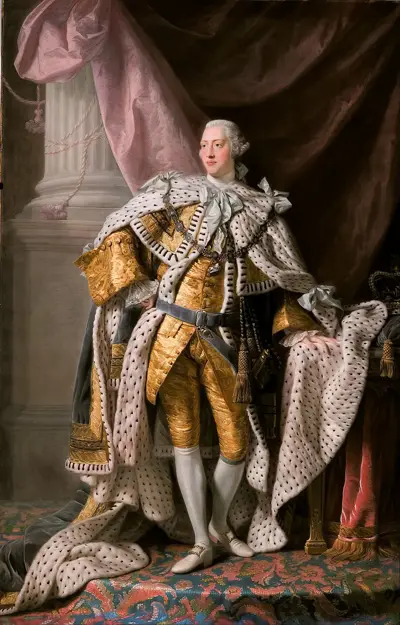
George III was King of Great Britain and Ireland from 25 October 1760 until the union of the two kingdoms on 1 January 1801, after which he was King of the United Kingdom of Great Britain and Ireland until his death in 1820. He was concurrently Duke and Prince-elector of Brunswick-Lüneburg ("Hanover") in the Holy Roman Empire before becoming King of Hanover on 12 October 1814. He was a monarch of the House of Hanover, but unlike his two predecessors, he was born in Great Britain, spoke English as his first language, and never visited Hanover.
