Woodrow Wilson Quotes
I have sometimes heard men say politics must have nothing to do with business, and I have often wished that business had nothing to do with politics.
Wilson, Woodrow. The New Freedom: A Call for the Emancipation of the Generous Energies of a People. Doubleday, Page & Company, 1913, p. 10.


Hollings who was one of the senior experienced senators was offended by the degree to which the George W. Bush Administration and the Republican leadership had turned to lobbyists to draft legislation and amendments to pending legislation. Lobbyists often have specialized information that members of Congress do not have, so there has been in modern times communications between lobbyists and members of Congress and their staffs. However, during the Bush Presidency the practice reached an extreme where lobbyists would even write the legislative language and give it to the members in whom they had invested by giving them large campaign contributions and many perks. K Street is the fanciest street in Washington DC with some of the most expensive office space. A substantial proportion of the lobbyists have K Street offices, hence the metaphor.


Wisconsin had a particularly tough lobbying law which was to be administered by the secretary of state, who found himself in the embarrassing position of discovering that he, himself, had technically violated the law by sending a signed, political mailing to a lobbyist. He turned himself in, and paid a $50 fine.


FDR even admitted that very wealthy men and corporations controlled most U. S. governments including the administration of his own political party. Roosevelt did a great deal to improve the situation but by the latter years of the 20th century, private financial entities gained back much of the influence and control. The result was the Meltdown of 2008 and the Great Recession, where another set of regulations and laws (Dodd-Frank) was made law by the Obama Administration. However, the financial corporations still had enormous political influence as a result of unlimited campaign contributions to politicians and unlimited lobbying.


Much public concern has been with moneyed interests buying influence, but the campaign contributions where members of Congress pressure (extort) contributions from companies and other organizations that might be harmed by legislation.

Mises is one of the very few economic conservatives who opposed companies getting involved with lobbying or politics in any way. He, like some others, saw the negative public effect that business produces when it does get deeply involved in politics, but he uniquely observed that the businesses themselves suffered as a result of the involvement in politics. Obviously very few business leaders of the 21st century agreed with Mises’ earlier views.


In 2014 he was accused of money laundering and placed under house arrest by the Russian Government. This typically was the first step in seizing some or all of his assets. When that is done, typically there are local and national politicians who will benefit as they will be able to “buy” the assets from the government at pennies on the dollar.


The “guidelines” were EPA Clean Air Guidelines that among other things would phase out coal fired power plants as coal was then the dirtiest fuel being used. The objections to these guidelines were the same as those that had been made for every other air quality or energy efficiency guidline that the Obama administration issued. They were also the exact same objections to all the guidelines issued by the Clinton Administration. And the same same arguments were made to oppose the original creation of the Enviornmental Protection Administrtion (EPA) by President Nixon’s Executive order on December 2, 1970. The economy has never been “crushed” but there is no way of knowing whether or not there would have been more jobs created if the Agency had not been created.


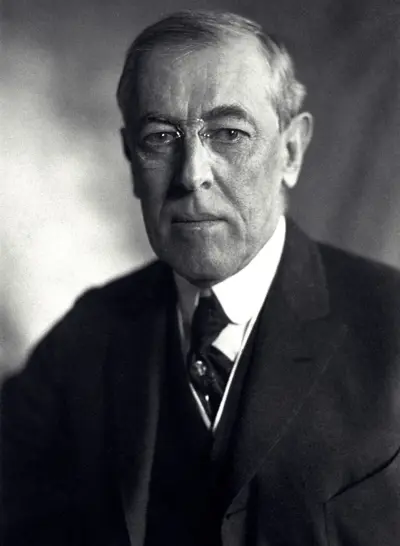
Thomas Woodrow Wilson was an American politician and academic who served as the 28th president of the United States from 1913 to 1921. A member of the Democratic Party, Wilson served as the president of Princeton University and as the 34th governor of New Jersey before winning the 1912 presidential election. As President, Wilson led the United States into World War I in 1917. He was the leading architect of the League of Nations, and his progressive stance on foreign policy came to be known as Wilsonianism. Scholars have generally ranked Wilson in the upper tier of U.S presidents, although he has been criticized for supporting racial segregation and white supremacy.
