Elizabeth I Quotes
I,_______________, do utterly testify and declare in my conscience, that the queen's highness is the only supreme governor of this realm, and of all other her highness's dominions and countries, as well in all spiritual or ecclesiastical things or causes, as temporal, and that no foreign prince, person, prelate, state or potentate, has, or ought to have, any jurisdiction, power, superiority, preeminence, or authority ecclesiastical or spiritual, within this realm; and therefore I do utterly renounce and forsake all foreign jurisdictions, powers, superiorities, and authorities, and do promise that from henceforth I shall bear faith and true allegiance to the queen's highness, her heirs and lawful successors, and to my power shall assist and defend all jurisdictions, pre-eminences, privileges, and authorities granted or belonging to the queen's highness, her heirs and successors, or united and annexed to the imperial crown of this realm. So help me God, and by the contents of this book
The main purpose of the oath was to eliminate Roman Catholics who recognized the Pope as the Supreme Ecclesiastical authority. The subtlety evaporated by 1640 when the official oath actually named Rome as the target. See {617547}.
Elizabeth I, 1533-1603, Queen of England, Oath required of all bishops, ministers and other clerics of the realm as well as all public officials and government agents, Supremacy Act, Restoring Ancient Jurisdiction, 1559
Sourced by: Eigen's Political and Historical Quotations

While this was directed at foreigners in general, the reason it was promulgated was to eliminate the influence of the Pope and his agents and the Catholic Kings of Europe and their minions.

All foreign immigrants were welcome provided they would “renounce” their allegiance to an foreign ruler or religious leader. The latter was really directed at Roman Catholics. European history had many instances where the Pope and the Vatican plotted with different forces to produce armed rebellion in various states to maintain a Catholic Establishment. England and Ireland were both the subjects of Papal revolutionary initiatives and the Americans were well aware of it. Popes and cardinals had ordered good Catholics to take various political positions including what was treason and sedition. The fear of political control of American Catholics motivated the inclusion of Ecclesiastical renouncement to become a naturalized citizen. Also note that it was the States who controlled citizenship at that time and not the Federal Government.

The Emperor had made his brother King of Holland, thinking of it as an unimportant backwater of the French Empire. But Louis took his oath and job very seriously, and although he did not have the great talent of his brother, he made a serious effort to be a good king.

This view almost got him killed. It was customary to swear loyalty to the government and those that would not were perceived to be traitors. The logic was that Christians feared for their souls more so than their lives so would not swear falsely. If there was no swearing, how was loyalty to be determined?

All members of Parliament were required to sign and publicly declare this oath. Two days later the Parliament ordered the oath—then called a “protestation”—printed and distributed throughout the realm. All minor officials and clerics were also required to make their “protestation.” It was excesses like this that created a negative attitude in England regarding loyalty oaths and the American Founding Fathers specifically knew of this—then relatively recent—example when they wrote the Constitution and the Bill of Rights. We have left the then English spelling as is.

There had been terrible religious wars between Catholics and Protestants in English history. The Protestants finally won and the Anglican Church of England became the “official” state church, but as England became a Democracy the power of the prelates and the church receded. However, there were fears of Catholic politicians in England that they were “controlled by the Pope” and if Catholics were too heavily part of the political system, the Pope might control and dominate English policy. Inge, one of the highest ranking Anglican clerics, allayed this fear, not by denying that the Popes and the Vatican might be interested in gaining more influence in England, but by appealing to the independence of the average Englishman and diminishing the spectre of the Pope by referring to him as an “Italian Priest.” As Inge and other high ranking Anglicans were in the English power system only English Priests. Inge at the time saw the Roman Catholic Church as a narrow, intolerant, monolithic anti modern institution. See {615671}. He argued that fear was inappropriate not because of the nature pf the Roman Church, but because of the characteristics of Englishmen, American Protestants had similar fears and Al Smith was defeated as President mainly because he was Catholic. For all but the worst religious bigots, this fear ended in America with the election of JFK.


Although Queen Victoria was modern and liberal in many respects, the idea of self-determination by majority vote was unthinkable and certainly undesirable for her. She was not opposed to lands and peoples changing empires and peoples per se. It was how the decision was made that was critical to her. Sovereigns had been buying, selling, and trading lands and peoples for centuries. And after wars, the winners would also reallocate the kingdoms of the loser. But the idea of a democratic plebiscite making the decision was unacceptable. To her and many others of the day, power struggles between factions, politicians, and sovereigns themselves would cause them to inflame the passions of the people and/or bribe the people to vote to change their allegiance. She saw popular but possibly unscrupulous politicians “blackmailing” kings and queens and if payments from the treasury would not be made, the politician would stir up a movement to transfer allegiance to another sovereign who might well be willing to pay.

This was before the state had officially sanctioned and accepted the church. Most of the institutions were pagan and the kings had subjects of both religions with Christianity not yet dominant. Yet among Christians, the Church had government temporal power, even before the church was allied with the state.
The revolutionary acts from some of the more radical colonists but the colonial power structure was trying to negotiate for changes from the taxation and rights-impinging laws that Parliament had passed. Within a year the Continental Congress would take a more revolutionary position when this petition yielded no betterment-- {636864} and {636958}.

At the time, The Oath of Supremacy, was required to take a seat in the British Parliament. It was specifically written to keep Roman Catholics out of Parliament. O’Connell and his colleagues adopted a political tactic whereby Catholics would run for Parliament, and then if an when they won, refuse to take the oath and hence be unable to take their seat. And that is just what happened. The Duke of Wellington, the Prime Minister, was trying to have Ireland join in union with Great Britain, and he didn’t want Irish Catholic anger and resentment because Irish seats in Parliament were empty by virtue of blatant religious discrimination. King George IV however was a virulent anti-Catholic, but Wellington finally persuaded him to relent and O’Connell and other Irish Catholics finally entered Parliament.

Prime Minister William Pitt, Edmond Burke, and Irish Patriot Henry Grattan had met with the king to discuss granting Irish Catholics rights to participate in government. The King was quite bigoted against Catholics, but England was at war on the continent and if Irish Catholics were angry enough, they might conspire with the Catholic French for an invasion of Ireland. When the Protestant members of the Dublin Corporation heard about the meeting, they immediately issued their own resolution to the King recommending the continued discrimination against Catholics. In a huge political battle in the English Parliament, Pitt and Burke were able to make some progress. The Penal Laws against Catholics that had been in force for a century were repealed. And Catholic men in Ireland were given the right to vote for members of the Irish Parliament. However, the Conservative Protestants blocked further reforms and Catholics were still not allowed to sit in Parliament of hold public office. Between this quotation and {639274} we see the Irish Protestants somewhat divided with the liberals wanting to give Catholics political equality and the Conservatives opposed.

The Fascist Dictator hinted at all the Church property that the State might seize and began to place taxes on the Church and in a brilliant political stroke actually negotiated the Lateran Pacts of 1929 with the Church whereby the Dictator would guarantee all the churches property and protect its officials end exempt the church from taxation and all the Church had to do was have all their Italian Bishops swear to this oath of political support for the dictatorial fascist state and its outrages and aggression and denial of rights. He actually have the church more religious power than they had enjoyed in Italy for years. For example he turned over the public school curriculum to the church with no other religion considered. Despite thus oath of the Italian bishops, there were a number of individual Catholic priests who aided the anti-Fascist resistance, but for the most part Mussolini bought the political and moral support of the Catholic Church. Apologists for the Church at the time point out that the entire Vatican and the Pope was totally within the dictator’s span of control, and he could jail any of the Holy see who criticized him or have them executed as he did so many others. He could also loot the Vatican and sell off holy relics and other object to finance his wars of aggression and his alliance with Hitler. They argue that there was nothing any priests could say that would break the iron hold Mussolini had on Italy and at least, the priests could perform their pastoral functions so long as they supported the Fascists. The debate continues to this day. However, after WWII Italians left the Catholic Church in droves and it is one of the least religious states in Europe.


Lee although born in England was one of the most ardent of the patriots fighiting the British. This oath was even considered extreme at the time. He was considered a super hawk by Washington and others. He became the Senior Major General and if anything had happened to Washington he would have command. He was an extremist who thought himself far more militarily qualified than Washington. See {59589} and {55885} for two of his slights against Washington.
The purpose was to try and get the king and parliament not to enforce the Stamp Act in the colonies. The delegates had to thrash out the language and it was important to flatter the king and parliament. While some delegates felt that loyalty to the mother country, many others thought that the king and parliament had betrayed them and thought this language gross hypocrisy. See {589426} for one delegate’s description of the difficulty.

This resolution was the trigger that began the debate which became the Declaration of Independence.

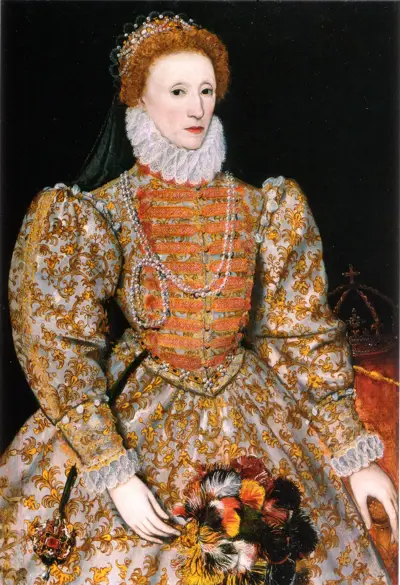
Elizabeth I was Queen of England and Ireland from 17 November 1558 until her death in 1603. Sometimes called the Virgin Queen, Gloriana or Good Queen Bess, Elizabeth was the last of the five monarchs of the House of Tudor.
