William Blackstone Quotes
The duty of a Privy Counselor appears from the oath of office [to require the Counselor] to keep the King’s counsel secret…[and] to withstand all persons who would attempt the contrary.
William Blackstone, 1723-1780, British Jurist, Commentaries on the Laws of England, 1783
Sourced by: Eigen's Political and Historical Quotations


All members of Parliament were required to sign and publicly declare this oath. Two days later the Parliament ordered the oath—then called a “protestation”—printed and distributed throughout the realm. All minor officials and clerics were also required to make their “protestation.” It was excesses like this that created a negative attitude in England regarding loyalty oaths and the American Founding Fathers specifically knew of this—then relatively recent—example when they wrote the Constitution and the Bill of Rights. We have left the then English spelling as is.


This view almost got him killed. It was customary to swear loyalty to the government and those that would not were perceived to be traitors. The logic was that Christians feared for their souls more so than their lives so would not swear falsely. If there was no swearing, how was loyalty to be determined?

Lee although born in England was one of the most ardent of the patriots fighiting the British. This oath was even considered extreme at the time. He was considered a super hawk by Washington and others. He became the Senior Major General and if anything had happened to Washington he would have command. He was an extremist who thought himself far more militarily qualified than Washington. See {59589} and {55885} for two of his slights against Washington.


The main purpose of the oath was to eliminate Roman Catholics who recognized the Pope as the Supreme Ecclesiastical authority. The subtlety evaporated by 1640 when the official oath actually named Rome as the target. See {617547}.

A Real is a a Brazilian unit of currency. The money was given illegally and might have determined the outcome of a national election. In an unusual example of party loyalty, he refused to implicate others in the party in the scandal. It is assumed that the money was used to bribe voters and/or local election officials to stuff the ballot boxes.

The statement originates from the English navy where one of the worst forms of punishment was to be whipped with a “Cat of Nine Tails”, a vicious 9 thong whip. On board ship, it was carried in a bag by a petty officer and removed for punishment. Hence the saying.


The leaks not only did not stop, but they became worse than ever.


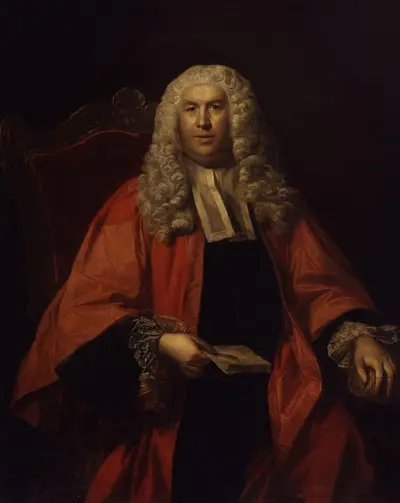
Sir William Blackstone SL KC was an English jurist, judge and Tory politician of the eighteenth century. He is most noted for writing the Commentaries on the Laws of England. Born into a middle-class family in London, Blackstone was educated at Charterhouse School before matriculating at Pembroke College, Oxford, in 1738. After switching to and completing a Bachelor of Civil Law degree, he was made a fellow of All Souls, Oxford, on 2 November 1743, admitted to Middle Temple, and called to the Bar there in 1746. Following a slow start to his career as a barrister, Blackstone became heavily involved in university administration, becoming accountant, treasurer and bursar on 28 November 1746 and Senior Bursar in 1750. Blackstone is considered responsible for completing the Codrington Library and Warton Building, and simplifying the complex accounting system used by the college. On 3 July 1753 he formally gave up his practice as a barrister and instead embarked on a series of lectures on English law, the first of their kind. These were massively successful, earning him a total of £453 (£71,000 in 2021 terms), and led to the publication of An Analysis of the Laws of England in 1756, which repeatedly sold out and was used to preface his later works.
