Woodrow Wilson Quotes
I am a most unhappy man. I have unwittingly ruined my country. A great industrial nation is controlled by its system of credit. Our system of credit is concentrated. The growth of the nation, therefore, and all our activities are in the hands of a few men. We have come to be one of the worst ruled, one of the most completely controlled and dominated Governments in the civilized world no longer a Government by free opinion, no longer a Government by conviction and the vote of the majority, but a Government by the opinion and duress of a small group of dominant men
There is some debate as to whether this statement was made at this time or different parts of it on two different occasions. The sentiment and position appears to be genuine but the issue of the timing is in doubt.
Woodrow Wilson, 1856-1924, 28th President of the United States (Democrat, NJ), Woodrow Wilson, after signing the bill that created the Federal Reserve
Sourced by: Eigen's Political and Historical Quotations


The President had a series of radio talks to the people in which he addressed them directly and explained things as he then understood them.

Stamp was a banker and the 2nd richest man in England at the time. Yet he warned about aspects of banking that needed reform and regulation.


This is essentially what happened in the Economic Meltdown of 2008 leading to the Great Recession.

By the middle of the 20th century, the banks were no longer allowed to control the railroads and seemed less powerful, but by the beginning of the 21st century, the few largest banks, without the railroads or any other industrial holdings, were so big that the controlled credit, fraudulently manipulated rates and mortgage foreclosures and after losing huge amounts speculating in 2008, the government had to bail them out with taxpayer money while the bank executives who caused the failures tool million dollar bonuses. Never were banks so powerful in any country that they could have the government pay billions of dollars for their losses and mistakes.


The business and financial institutions actually follow the statements and actions of an administration and its officials very closely, seeking “signals” of what action the government might take in the future. The actions that they take today may not become operational for several years (like building a new factory), so they try very hard to find out what the business and economic climate might be in the years to come. Sperling, like other very sophisticated economic advisers, realized that the President and his administration can often do little directly to influence the economy, but they can control what they say and the actions that they do take, to alter the perception of the economists, financiers, and business people throughout the nation.

Executed by the English for his part in the Easter Uprising. Connolly was a socialist advocate as well as a republican. He was one of the first revolutionaries to understand that military occupation was only a part of forces that kept a nation subservient to another. However, attempts to break those economic ties have almost always led to economic ruination.

There were little controls over usury in his time in India. Villagers often paid 500% or more to borrow money in a necessity like needing critical health care.
FDR even admitted that very wealthy men and corporations controlled most U. S. governments including the administration of his own political party. Roosevelt did a great deal to improve the situation but by the latter years of the 20th century, private financial entities gained back much of the influence and control. The result was the Meltdown of 2008 and the Great Recession, where another set of regulations and laws (Dodd-Frank) was made law by the Obama Administration. However, the financial corporations still had enormous political influence as a result of unlimited campaign contributions to politicians and unlimited lobbying.


America’s first political economist


At the time, the economy was virtually controlled by the banks and others in the finance, as opposed to businesses that produced things or provided non-financial services to consumers and business which was that had prevailed ever since the Great Depression, when New Deal legislation controlled the banks, stock markets, and other facets of the financial industry.


The last sentence echoes a quotation of Napoleon. See {630664} .
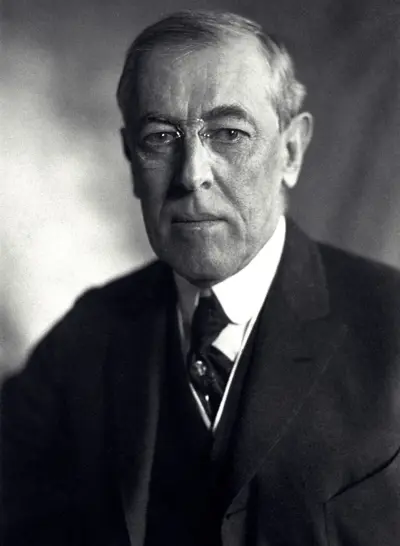
Thomas Woodrow Wilson was an American politician and academic who served as the 28th president of the United States from 1913 to 1921. A member of the Democratic Party, Wilson served as the president of Princeton University and as the 34th governor of New Jersey before winning the 1912 presidential election. As President, Wilson led the United States into World War I in 1917. He was the leading architect of the League of Nations, and his progressive stance on foreign policy came to be known as Wilsonianism. Scholars have generally ranked Wilson in the upper tier of U.S presidents, although he has been criticized for supporting racial segregation and white supremacy.
